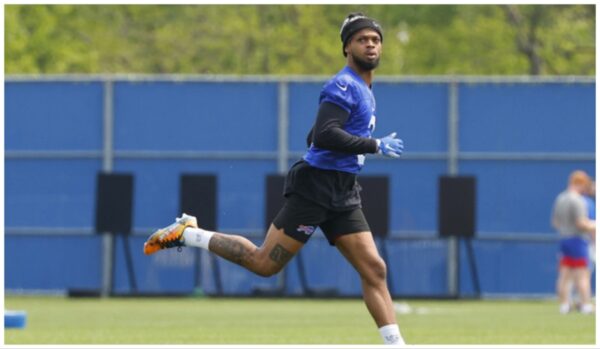
Buffalo Bills safety Damar Hamlin shocked the world with his near-death experience five months ago followed by a miraculous recovery. Now the 25-year-old is already back at practice.
Hamlin went into cardiac arrest during a Jan. 2 Monday Night Football game against the Cincinnati Bengals. He had to be resuscitated on the field after what appeared to be a routine tackle and spent time in the hospital in critical condition. He was cleared to play in April after seeing three different heart specialists, according to ESPN.
Dr. William Knight IV is one of the doctors that diagnosed Hamlin with commotio cordis, which, according to the National Library of Medicine, is “ventricular fibrillation precipitated by blunt trauma to the heart.” Knight, who’s part of Hamlin’s care team, is a professor in the Department of Emergency Medicine at the University of Cincinnati College of Medicine and director of the Emergency Medicine MLP Program.
Commotio cordis is common in the sudden death of young athletes, according to the NLM.
Bills’ leadership has indicated that Hamlin is not in full pads and is currently not wearing a helmet.
“We’re taking it one day at a time and just support Damar in every way possible,” Bills head coach Sean McDermott said to reporters.
Too Soon?
Despite the slower efforts to ease him back into football, it still may be too soon for Hamlin.
Social media users heavily criticized the Miami Dolphins organization for rushing quarterback Tua Tagovailoa after he suffered three concussions last season, including two in back-to-back weeks. It resulted in Tagovailoa missing a total of five games and put the Dolphins’ medical staff on blast for diagnosing his first concussion as a back injury. The young Dolphins quarterback recently came out and said that he considered retirement.
“I considered it for a time, having sat down with my family, having sat down with my wife and having those kind of conversations, but it will be hard for me to walk away from this game with how old I am,” Tagovailoa told reporters in April.
As for Hamlin, he said that playing football and being around his teammates is good for his mental health. That is probably true, but we have to teach our young athletes to learn to find interests outside of sports that are good for their mental health. We also can’t criticize them when they do find other interests outside of sports and say they are not focused on athletics.
Athletes are usually taught at a young age by youth coaches to be willing to live and die for their sport. For decades, youth coaches have sent the wrong message to young athletes, especially football players. They have continuously preached the message of “suck it up,” “if it’s not broken (bone) then you are not hurt,” and the “no blood, no foul” mantra. Those outdated ways came back to haunt the game of football with the discovery of Chronic Traumatic Encephalopathy better known as CTE.
Future of Football
Though Hamlin was discovered to have a heart condition, he is playing a dangerous sport and shouldn’t be rushed to return to the field. Chuck Hughes reportedly remains the only player in NFL history to die on the field. He died in 1971 of a heart attack while playing for the Detroit Lions.
Bills teammate Stefon Diggs described the scene when Hamlin was hurt as emotional. He said guys were crying on the field, and he was conflicted between crying and getting guys ready to go finish the game.
Diggs’ emotional moment sheds some light on the concern American parents face when weighing thoughts over whether to let their kids play football.
According to NBC 4, a survey conducted by Ohio State University in 2022 showed that 50 percent of the 4,000 parents that participated in the survey do not think tackle football is appropriate for children to play. The same survey showed that 45 percent of parents agree and the other 5 percent are undecided.
Athletes like LeBron James, Adrian Peterson, and Troy Aikman have spoken out about not wanting their kids to play football because of the game’s possible dangers to the body and health.
“I think that we’re at a real crossroads, as it relates to the grassroots of our sport because if I had a 10-year-old boy, I don’t know that I’d be real inclined to encourage him to go play football, in light of what we are learning from head injury,” said Aikman to HBO’s “Real Sports” talk show in 2014.


