A Louisiana man was finally released from prison on Monday after spending 29 years behind bars for a rape he and the victim said he didn’t commit.
Patrick Brown was convicted in 1994 on charges of raping his then-6-year-old stepdaughter. At the time, the stepdaughter was pulled off the stand before she could testify that another family member committed the rape. Brown subsequently was convicted on what Nola.com describes as hearsay testimony and inconclusive evidence and sentenced to life without parole.
The victim began to write a series of more than 100 handwritten letters in 2002 to the courts and Orleans Parish District Attorney’s Office that asked for the case to be reviewed because Brown wasn’t her attacker. She also said that the prosecutors were aware that he didn’t rape her and it was another family member.
“I’ve written over 100 letters … mailed them to the DA’s office. I’ve shown up unannounced to talk to someone and been turned around,” the victim told The Guardian.
Brown and the victim’s efforts were ignored until last year. The civil rights division of the Orleans Parish District Attorney’s Office reopened the case for another investigation and found that Brown was innocent. Emily Maw, head of the civil rights division, led the efforts to help get his conviction overturned.
“This is a case,” Maw wrote in the court filing, “of finally listening to a woman who, for over 20 years, has been telling the state that the wrong man is in prison.”
The civil rights division was reportedly created by Orleans Parish District Attorney Jason Williams in 2021 to examine past harms in the criminal legal system. According to The Guardian, Brown filed a claim of factual innocence under a new law as a pro se application, which means he had no legal representation.
Brown was convicted under former Orleans Parish District Attorney Harry Connick Sr. Orleans Parish reportedly once led the nation with the highest per capita rate of wrongful convictions, according to the University of Michigan’s National Registry of Exonerations. Last year, Louisiana reportedly exonerated nine people, including eight people who was convicted in Orleans Parish.
“They have more than me behind those walls looking for their truth to come out,” Brown said to Nola.com.
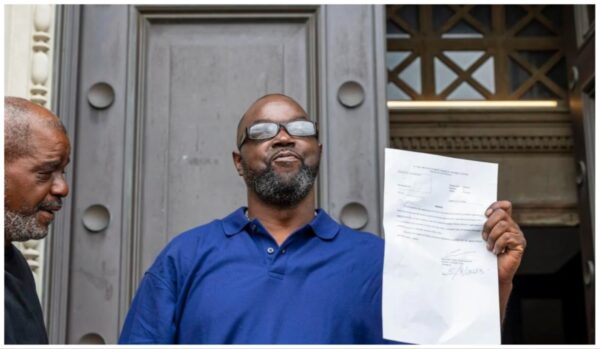
On Monday, Brown went to the same courtroom he was convicted in 1994 and finally received the outcome he had been dreaming about. He was exonerated and left the Louisiana courtroom holding his documents.
“This is it,” Brown said to Nola.com, clutching a one-page court order. “This is the freedom paper that I have been waiting for all my life.”
While in court, Brown reunited with his stepdaughter and apologized.
“I was telling her I’m sorry it happened to her,” he said to Nola.com. “I was telling her I failed as a father. I was supposed to protect my household, and I didn’t.”
Williams didn’t provide details on the exonerating evidence but told CBS News the civil rights division “conducted a thorough investigation and the evidence corroborated the victim’s account, which has remained steadfast for over 20 years.”
The victim signed an affidavit in 2015 that named the other family member who allegedly raped her.
“It is incredibly disheartening to know that this woman was dismissed and ignored, no matter how inconvenient her truth, when all she wanted was the real offender to be held responsible,” Williams said in a statement on Monday. “When someone is wrongfully convicted, not only is it an injustice for the person who has years of their life stolen, but it is an injustice for the victim and the people of New Orleans because the real perpetrator is left to harm others.”
Brown’s case reportedly is just the 16th time since 1991 that a rape conviction was overturned in Louisiana.
“Thank you for listening, finally,” the survivor said to Nola.com. “Thank you for hearing me. Thank you for helping me tell the truth. Thank you for helping our family heal. Thank you for giving me my dad back.”
“I never gave up hope. If you’re incarcerated, you can’t give up hope. If you give up hope, you’re dead,” said Brown.


