One of the most iconic pieces of Black art has fetched an eight-figure auction bid. The work, made popular by a 1970s hit sitcom, was sold for 76 times more than the seller’s estimated value.
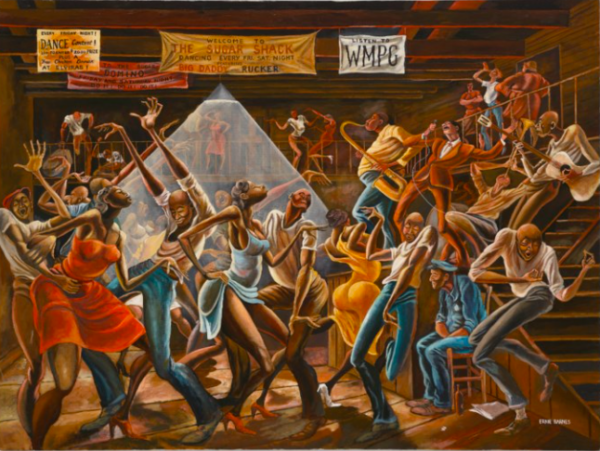
On Thursday, May 12, “The Sugar Shack,” the piece of art made famous on the classic Norman Lear television show “Good Times” and featured as cover art on Marvin Gaye’s iconic “I Want You” album, has sold for $15.3 million at Christie’s 20th Century auction.
The masterpiece is a pictorial snapshot of a jam at the Durham Armory, a famous dance hall in North Carolina, in 1952, according to Artnet. It shows Black bodies bending and stretching to a beat no one can hear — and now the work belongs to a hedge fund manager and entrepreneur, Bill Perkins, who said he would have paid more for it if he had to.
“I stole it,” the 53-year-old said. “I would have paid a lot more. For certain segments of America, it’s more famous than the ‘Mona Lisa.’ ”
In an interview with Artnet after his historic night, Perkins spoke bittersweetly about avoiding a bidding war with “Hong Kong, or Russian oligarchs or French billionaires” and understanding why that war didn’t take place in the first place.
“As a novice, I’m buying what I like. There is American art, and there’s Black art and Black artists, and its like this sub-category,” Perkins noted.
“I don’t know all the reasons, I think collectors before thought, ‘Well I’m going to support this,’ and there was this kind of charitable endeavor to it. When I came along, I’m thinking, ‘These are basically free.’ This is such an integral, foundational part of history. Black history is why America is an empire. These stories are important, but it’s as if people have been put it in this other category.”
This is not the first time Barnes or his work has been compared to classical art staples. The Oakland Tribune once called him “Picasso of the Black art world.”
Perkins said he knew he wanted to be in person for the auction, anxious that a celebrity would swoop in and outbid him. The Houston resident said he thought to himself, “What if Oprah shows up? What if P. Diddy shows up? I’m not going to be able to buy this piece.”
So, he devised a simple, but effective plan: raise the paddle at all cost — even at his own expense.
He said he instructed his fiancée, Lara Sebastian, who traveled with him, and said, “Hey, babe, if I have a problem or I pass out, do not worry about me: Keep bidding.”
Read full story at Finurah here.


