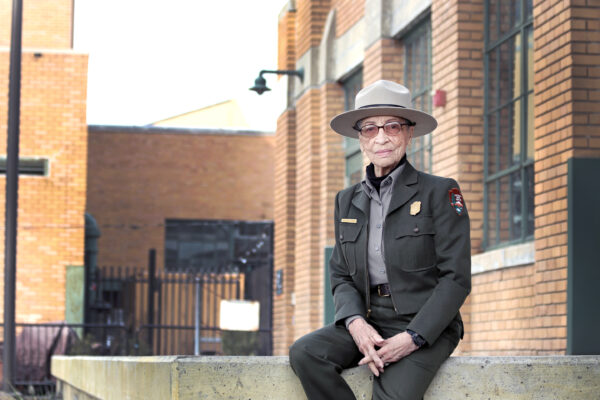
After spending the last decade and a half sharing her story and the efforts of other African-Americans in World War II, Betty Reid Soskin has hung up her hat as the nation’s oldest park ranger at age 100.
Soskin, who celebrated her 100th birthday in September, is a prominent national figure. She was once named Woman of the Year by the California legislature and has been awarded for her dedication to telling lost stories of World War II. Her worked has garnered so much attention that in 2015, she was selected by the National Park Service to introduce former President Barack Obama at a White House tree-lighting ceremony.
“To be a part of helping to mark the place where that dramatic trajectory of my own life, combined with others of my generation, will influence the future by the footprints we’ve left behind has been incredible,” Soskin said in a March 31 statement announcing her retirement.
Soskin spent her last day on the job as an interpretive guide at the Rosie the Riveter/WWII Home Front National Historical Park. She helped develop the plan for the park and made sure it included a program and funding to recognize African-Americans involved in the war at home.
According to the National World War II Museum, more than one million Black men and women served in every branch of the U.S. military during the war. Soskin worked in a segregated union hall in Richmond, California, during World War II as a file clerk, where thousands of women helped build more than 700 Liberty and Victory ships.
Soskin also reportedly worked for the U.S. Air Force in 1942 but quit after learning that she was hired because she passed for white, according to NPS. She is the first Black woman to win the Silver Medallion Award at the World War II Museum in New Orleans, awarded to her in 2016.
Soskin, born Betty Charbonnet, grew up in a Cajun-Creole, African-American family that migrated to Oakland, California, after the “Great Flood” in New Orleans” in 1927, according to NPS.
Two decades later, she and her husband co-founded one of the first Black-owned music stores, Reid’s Records, in Berkeley. It withstood the digital age, closing in fall 2019, when Soskin also suffered a stroke. Soskin was always a community steward, spending years as a political staffer and postal worker.
She started sharing stories about the historic park in the early 2000s when she was in her 80s. She secured grant funding to include Black War World II stories, and created a temporary position as a guide for herself in the park. The position became permanent in 2011, when Soskin was 90 years old.
“Being a primary source in the sharing of that history – my history – and giving shape to a new national park has been exciting and fulfilling,” Soskin said. “It has proven to bring meaning to my final years.”
NPS created a special limited-edition ink stamp for Soskin’s centenarian celebration. She received an outpouring of well-wishes on her 100th birthday from hundreds of thousands of people on social media.
“The National Park Service is grateful to Ranger Betty for sharing her thoughts and first-person accounts in ways that span across generations,” said Naomi Torres, acting superintendent of the park. “She has used stories of her life on the Home Front, drawing meaning from those experiences in ways that make that history truly impactful for those of us living today.”