A California judge tossed out a civil complaint against the city of Palo Alto filed by six officers alleging harassment and discrimination. The lawsuit claims that the city “forced” them to “pass” a Black Lives Matter mural on a public street near their precinct, causing them “humiliation” and “mental anguish.”
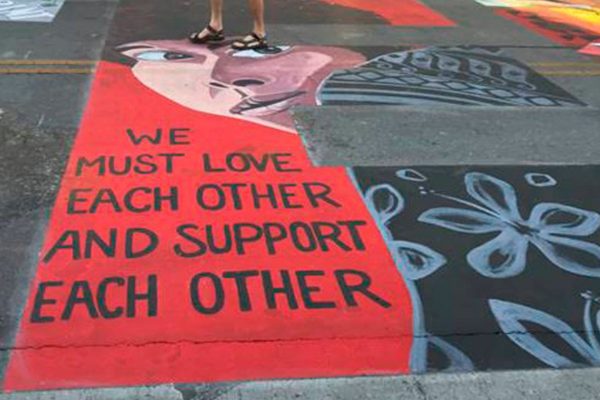
The group objected to the piece of art because it featured a quote from Assata Shakur, a 1970s Black Liberation Army member.
According to The Mercury News, the Santa Clara County Superior Court dismissed the June 2021 lawsuit against the City of Palo Alto filed by police officers Eric Figueroa, Michael Foley, Christopher Moore, Robert Parham, Julie Tannock, and David Ferreira.
The cops sought from the city compensation for alleged physical, mental, emotional, and economic damages they incurred as a result of the mural being across from their place of employment.
The 245-by-17-foot mural was temporarily installed in downtown Palo Alto to pay tribute to George Floyd after his 2020 murder. It also depicted other Black civil rights leaders and activists, including Shakur, who is quoted inside of one of the letters in the phrase “Black Lives Matter.” Shakur’s inclusion — which also depicted a picture from the cover of her autobiography — created controversy, as she is an international fugitive, becoming the first woman ever to be placed on the FBI’s Most Wanted Terrorists list.
The 74-year-old remains in Cuba since escaping prison in the late 1970s after being convicted of fatally shooting New Jersey State Trooper Werner Foerster during a traffic stop on May 2, 1973.
The lawsuit stated that the men were also suing for health care services, attorney fees, and court to be paid at costs yet to be determined but “in excess of $25,000.”
The claim stated that the men were “forced to physically pass and confront the mural every time they entered the Palo Alto Police department.” The police said the street art was “offensive, discriminatory and harassing iconography” that created a “hostile” and “retaliatory” work environment for them.
According to documents filed on Thursday, March 3, Santa Clara County Superior Court Judge Socrates Peter Manoukian tossed out the case, ruling that none of the plaintiffs successfully proved they were discriminated against by the city, KCBS Radio reports.
The justice submitted that they did not “adequately allege” that the city “subjected” the six cops “to an adverse employment action or that there is some causal link between the protected activity and the employer’s action (retaliatory motive).”
“There is nothing to suggest that the mural and its iconography was created in favor of one group over another,” the judge wrote in reference to the now removed artwork.
“Similarly, Plaintiffs do not provide any factual allegations which would suggest defendant City’s refusal to address Plaintiffs’ complaints about the Mural are based on Plaintiffs’ race, ethnicity, or some other protected classification.”
The City of Palo Alto’s lawyers submitted in three separate filings that the officers’ claims of workplace harassment were unfounded. Manoukian agreed with the city, ruling that the municipality did not perpetrate retaliatory acts against the men.
“The court finds persuasive defendant City’s argument that Plaintiffs have not adequately alleged any adverse employment action taken against them by defendant City to support a claim for discrimination,” Manoukian wrote.
He also maintained that despite working in law enforcement, the officers “are not a protected class” as argued by their lawyers.
According to the California State Senate, there are 18 protected classes. Race, gender, gender identity, religion, disability, military or veteran status are a few of the categories. Law enforcement is not listed.


