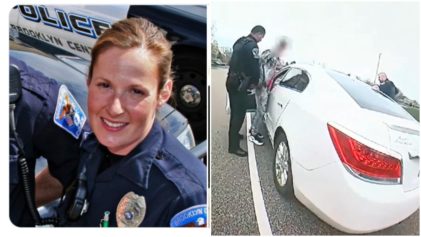
The jury in the Kim Potter trial asked the judge what happens if they “cannot reach a consensus” on Tuesday, Dec. 21, after deliberating for 13 hours, indicating a possible deadlock.
Potter is facing first and second-degree manslaughter charges in the April 2021 shooting death of Daunte Wright.
The former Brooklyn Center, Minnesota, police officer shot 20-year-old Wright as he tried to drive away from a traffic stop. Police said Wright was stopped in the Minneapolis suburb of Brooklyn Center for having expired car registration tags, and officers found he had a warrant for his arrest because of a missed court date.

Potter claims she mistook her gun for a Taser when she shot Wright. The jury heard closing arguments in the trial on Monday.
On Tuesday evening, Hennepin County District Judge Judge Regina Chu read the jury’s question for the court, “If a jury cannot reach consensus, what is the guidance around how long and what steps should be taken?”
In response, Chu read a portion of the instructions provided to the jury on Monday.
“You should decide the case for yourself but only after you should have discussed the case with your fellow jurors and have carefully considered their views,” the judge said.
“You should not hesitate to re-examine your views and change your opinion if you become convinced they are erroneous, but you should not surrender your honest opinion simply because other jurors disagree, or merely to reach a verdict.”
The jury also asked to hold Potter’s gun outside of the box where it is secured with zip ties.
Chu agreed a deputy could remove the gun from the box for jurors to handle.
Jurors include nine white people, two Asian people, and one Black person. Deliberations ended at 6 p.m. on Tuesday and will resume on Wednesday morning.
The defense objected to Chu’s decision to read a portion of the jury instructions and to her decision to allow jurors to handle the gun outside of the box. Chu overruled both objections.
Potter testified last week that she intended to fire her Taser at Wright to prevent her partner, Sgt. Mychal Johnson, from being dragged by the vehicle if Wright tried to flee.
Johnson had leaned into the vehicle to place Wright in handcuffs.
“I’m sorry. … I didn’t mean to hurt anyone,” Potter said tearfully from the stand.
Potter said she remembered yelling “Taser” before Johnson told her she’d shot Wright.
The defense called psychologist Laurence Miller to the stand last week.
Miller explained that “action error” is when a person “intends to do one thing, think you’re doing it, but do something else and later realize it.” He said confusing a gun for a Taser is a typical example of weapon confusion.
Brooklyn Center officers are required to keep their Tasers and guns on opposite sides of their belts. The two weapons vary significantly in weight, color and grip-type.
Potter faces up to 15 years in prison if convicted on both counts.
More news from our partners:
Video Shows Indiana Black Man Nearly Lynched By Group of White Men In Woods: ‘Get a Noose’