When astronaut Dr. Jessica Watkins makes her first trip to space she will have reached a dream-like career milestone, but that is not all.
Next year Watkins, a geologist — her colleagues endearingly refer to her as a “rock nerd” — will become the first African-American woman astronaut to join the International Space Station (ISS) orbiting outpost for an extended trip, in her case six months. But that assignment will be just the prelude for a much bigger space mission for the scientist: A landing on the moon under the Artemis program.
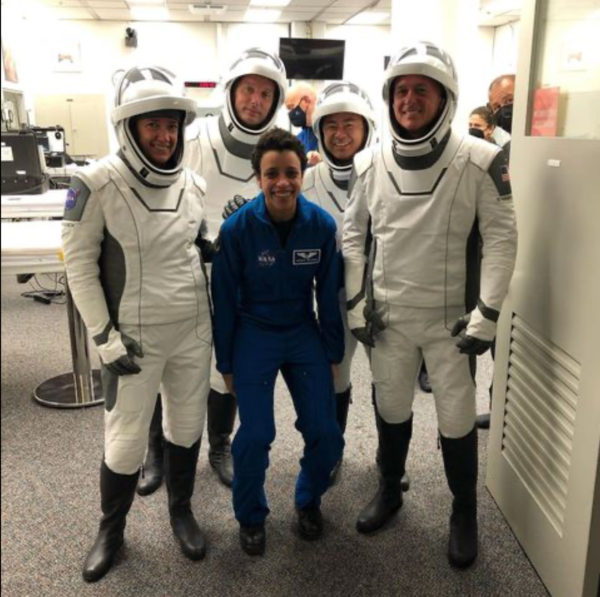
“It is certainly not lost on me that we’ve arrived in this moment in history,” the 33-year-old Watkins said this week. “This moment is not as worthwhile if we are not able to focus on the job and perform well.”
Watkins along with astronauts Kjell Lindgren, Robert Hines and Samantha Cristoforetti of the European Space Agency — together they make up Crew-4 — are expected to embark on their mission to the ISS from the Kennedy Space Center in Cape Canaveral, Florida, in April 2022 aboard the SpaceX Crew Dragon capsule.
(That should provide plenty of time to work out any of the SpaceX craft plumbing glitches like the one earlier this month that forced a four-person crew to return from the ISS to Earth in diapers because the toilets on the SpaceX Crew Dragon Endeavor were broken.)
In its 21-year history only seven Black astronauts have boarded the ISS; although in total 249 people have been onboard. Jeanette J. Epps was slated to become the history-making Black astronaut on a six-month mission at the ISS in 2018, however she was replaced for a “number of factors,” according to a NASA spokesperson.
Watkins background consists of earning a bachelor’s degree in geological and environmental sciences from Stanford University, a doctorate in geology from the University of California, Los Angeles. Last December, Watkins and several others were announced as members of the Artemis program, which is slated to start in 2024.
“A dream feels like a big, faraway goal that is going to be difficult to achieve, and something that you might achieve much later in life,” she said in an introductory video about being announced as part of the Artemis team.
“But in reality, what a dream is — or a dream realized is — is just putting one foot in front of the other on a daily basis. And if you put enough of those footprints together, eventually they become a path towards your dreams.”
NASA said in its statement about the resumption of manned moon landings: “We’re going back to the Moon for scientific discovery, economic benefits, and inspiration for a new generation of explorers: the Artemis Generation. While maintaining American leadership in exploration, we will build a global alliance and explore deep space for the benefit of all.”
More news from our partners:
Sky’s the Limit: Black Contractors Wants To Build Tallest Skyscraper in NYC History


