Grammy nominated Hip-hop artist, Sergio “Gunna” Kitchens teamed up with Goodr CEO and founder, Jasmine Crowe, to address food insecurity at a Fulton County, Georgia, middle school.
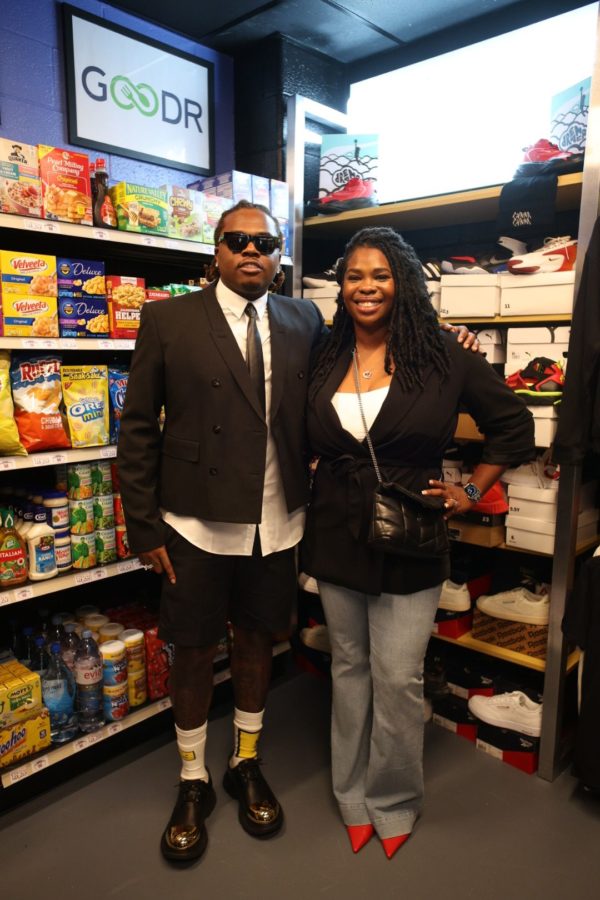
On Sept. 16, 2021, Kitchens and Crowe were welcomed with open arms by students, teachers, and faculty as they unveiled ‘Gunna’s Drip Closet and Goodr Grocery’ at Ronald McNair Middle School in the Atlanta suburb of College Park.
The Title I school has an enrollment of 833 students, with a mostly Black student population of economically and educationally disadvantaged children.
For students to use the school store, their family must be registered online or through the Goodr app, where they express their need, then a school faculty member will escort the student to the store to fulfill the request.
Crowe says the school store cost $50,000 to set up and fully stock with nutritious food and clothes. She knew Ronald McNair Middle School would be a perfect fit because Kitchens attended the school and the student population has higher needs.
“The school was a really low-performing school; it had an F, then under [school Principal, John Madden Jr.’s] watch, got up to a C. Then I found out Gunna and his four brothers went there and at times his mom would substitute in the school cafeteria,” said Crowe.
In 2017, Crowe founded Goodr and through her company sought to fight hunger.
On Sept. 8 the U.S. Department of Agriculture released its annual food insecurity report. Throughout 2020, food insecurity increased for Black households from 19 percent in 2019 to 21 percent by December 2020. The report also found food insecurity was highest in Southern states.
Crowe believes society must rethink how it addresses hunger. She specifically criticizes large organizations aimed to address food insecurity, saying they exhaust most of the money and resources to root out hunger in communities leaving smaller organizations with very little.
“The foodbank has always been receiving donations and people are still hungry. So why don’t we say, ‘Hey, let’s look at some other options, let’s fund this.’ And maybe because I’m a Black woman, I’m in Atlanta and I’m saying things no one wants to have said, we don’t get the same support, but I do think we make the most impact,” she said.
During the school store unveiling, Crowe says there was a bit of a stir on social media when her viral tweet that showed a portion of the store in a photo garnered thousands of likes and comments, some of them negative.
“I only showed one of our shelves, and people were like, ‘Oh, there’s nothing healthy,’ but there really was, we were really concentrated. We made sure there were vegan options, there were fruits and vegetables,” she said.
Crowe says food items placed in the store were intentionally selected to specifically meet the needs of the cash strapped families with ties to the school.
“The idea for this store is understanding that a lot of these kids are the adults, they are the secondary adults in the households. They’re going home, their parents are still at work, and they are often cooking meals for their little brothers or sisters, that’s why there’s Stouffer’s lasagna in there. A kid can say, this can go in the oven for 45 minutes and me and my little brothers can have food tonight,” said Crowe.