A family has filed a lawsuit against the city of Baton Rouge and the city’s police department after a 16-year-old with asthma was pinned to the ground with an officer’s knee on his neck following a July 2020 traffic stop, according to the legal claim.
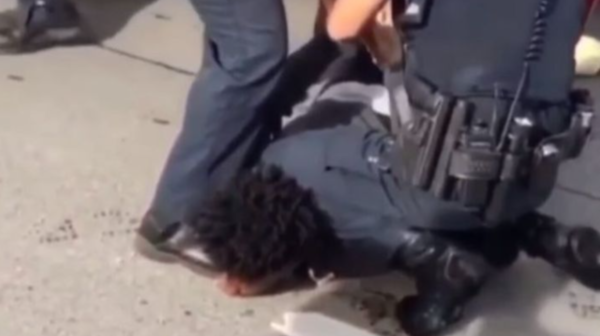
Dillion Cannon, referenced in the suit as “D.C.” was pinned to the ground as an officer’s knee “was pressing on D.C.’s neck for close to 30 seconds, restricting his ability to breathe, before the arresting officers collectively jerked him up off the ground, yanking his arms backwards,” according to the lawsuit obtained by Atlanta Black Star.
But according to BRPD officials, necks are off-limits and the method wasn’t used to restrain the teen.
“A knee on a back is used as a control method,” Sgt. Myron Daniels said at a press conference last year, The Advocate reported. “But the neck is off-limits.
On July 6 last year, Cannon was a passenger in a vehicle that failed to stop when an officer attempted to pull the car over for a seat belt violation. About 50 minutes into the pursuit, and after the driver ignored multiple traffic lights and stop signs, the vehicle came to a stop. The legal claim says the driver and passenger both exited next to the car and held their hands above their heads. The driver was arrested without incident by one set of three officers. According to the suit filed by Tenesha Cannon, the teen’s mother, even though Cannon was kneeling and complied with commands from another set of three officers, he was held at gunpoint and “forcefully handcuffed.”
The family’s attorney Ron Haley agreed that the level of force wasn’t necessary considering the teen complied after exiting the vehicle. “Our client, her son, was a passenger. He doesn’t control the car.. he doesn’t drive it, on his knees, in a submissive position and yet he was handled as if he was a threat,” said Haley at a press conference outside of the police department days after the incident. “When you are on your knees with your hands up, you don’t get much more submissive than that. Why was he handled in such a rough manner? He was not armed. He was not posing a threat to anyone for him to be treated that way.”
The suit identifies the officers who drew their weapons on Cannon as Lorenzo Coleman, Travis Williams, and Douglas Schutz. Despite the fact that Cannon, who was prone on the ground, “did not resist at any time,” according to the suit, officer Alvaro Alvarez “placed his left knee on the back of D.C.’s neck as he grabbed and pulled D.C.’s left wrist behind his back.”
According to the suit, Cannon told officers he suffered from asthma, and an officer responded, “I don’t give a damn.” The knee remained on Canon’s neck for 30 seconds, the suit says. In addition, while BRPD officials claim Alvarez’s knee was on Cannon’s back, “the body camera footage, and the cellphone videos taken by bystanders, clearly indicates that the knee was squarely on D.C.’s neck and back,” the suit says.
The incident happened just six weeks after the highly publicized death of George Floyd, who was killed after former Minneapolis officer Derek Chauvin kneeled on his neck, the suit notes.
The suit also says that no other officers intervened as Alvarez kneeled on Cannon and that the teen had to wear a neck brace after the incident.
“It is unconscionable and reprehensible that less than two months after George Floyd was murdered by an illegal police tactic, the Baton Rouge Police would use that maneuver against a child,” Christoper Murell, an attorney representing the Cannon family, told VICE News.
The family is seeking damages for injuries sustained as a result of the defendant’s actions, as well as attorneys fees.