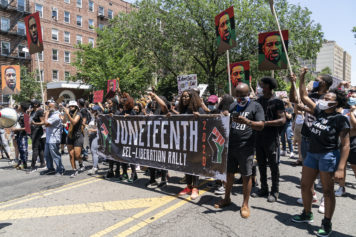
Only days remain for Georgians in Fulton County to apply to have their records of old nonviolent offenses removed in conjunction with a Juneteenth record restriction/expungement summit. Atlanta is Fulton’s county seat.
Since April 19 the Fulton County Office of Solicitor General, along with The Temple, Ebenezer Baptist Church, the Georgia Justice Project and the Martin Luther King Sr. Community Resources Collaborative have collected applications in hopes of helping 300 individuals with misdemeanor strikes against them conceal those criminal history records from public view (such records will remain available to law enforcement agencies). The deadline to apply is April 30.
“We are excited to partner with our justice-loving friends as we commemorate Jubilee Day, Juneteenth, by removing the barriers created by decades of mass incarceration, poverty, and so many other societal ills that have unnecessarily left so many good people with a criminal record,” said Fulton County Solicitor General Keith E. Gammage in a press release. “Removing these old records represents a new kind of freedom.” (Gammage’s office is responsible for prosecuting misdemeanors in Fulton County.)
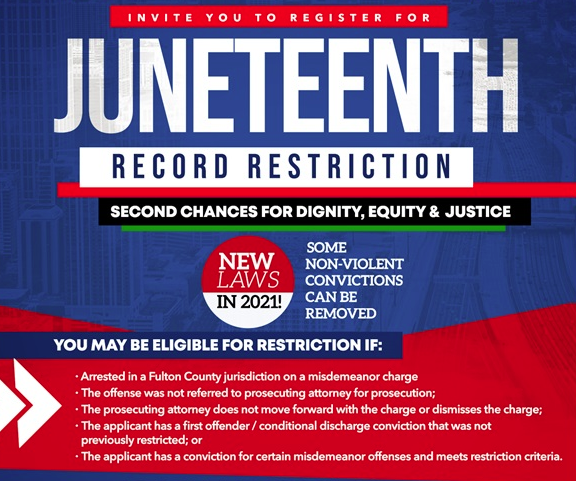
In Georgia, a person’s criminal history was a permanent blemish on their record until the unanimous passing of the “Second Chance” law (Georgia Senate Bill 288) in June 2020. The law, which went into effect Jan. 1, could help lift barriers to housing and employment that have disproportionately impacted Black communities.
“It’s a rather modest change for expungement compared to some other states, but it’s a really major change for employer liability,” said Brenda Smeeton, legal director at the Georgia Justice Project (GJP), in an interview with Georgia Public Broadcasting.
The symbolism of expunging records on Juneteenth is tied to the day on June 19, 1865 — two years after the issuance of the Emancipation Proclamation declaring all slaves in Confederate states freed and two months after the effective end of the Civil War — when Union Major-General Gordon Granger arrived in Galveston, Texas, and proclaimed Emancipation Day, freeing Black Texans who remained in bondage.
“The historical legacy of Juneteenth shows the value of never giving up hope in uncertain times,” as stated by The National Museum of African American History and Culture. Since then, after generations of Juneteenth being observed as an informal regional holiday by Black Texans, a national movement has taken hold to mark the day as a Black Independence Day, with many people incorrectly viewing the date as marking the end of slavery in the United States. (The Emancipation Proclamation only applied to slave states that had joined the Confederacy. Legal slavery persisted in states such as Kentucky and Delaware until the ratification of the 13th Amendment on Dec. 6, 1865.)
Stipulations for record expungement consideration include:
- The crime(s) must be committed in Fulton County.
- Must also have no current charges pending in any jurisdictions and have had no convictions within the past four years.
- Mostly, convictions for family violence crime, sex crimes, certain theft crimes, and serious driving offenses (such as driving under the influence and reckless driving) do not qualify.
- All cases that were previously eligible for restriction under the previous law can still be restricted.
Those interested in seeking a record restriction for a misdemeanor offense can apply at FultonRestorativeJustice.org or call The Fulton County Office of Solicitor-General at 404-612-4827. Those selected will be notified by June 19.