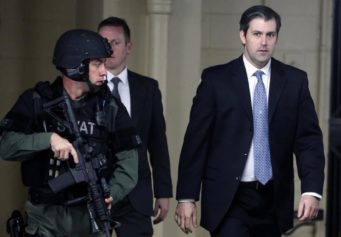
A judge upheld a 20-year prison sentence on Monday for a former South Carolina police officer convicted in the 2015 shooting death of unarmed Walter Scott.
Federal Judge Richard Gergel rejected former officer Michael Slager’s claim that his attorney, Andy Savage, had offered ineffective counsel while he was on trial for shooting Scott five times in the back after a traffic stop.
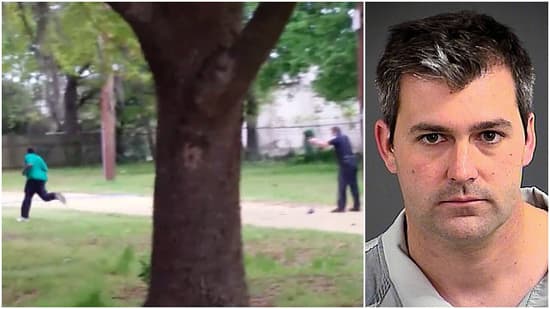
Slager, 39, filed an appeal of his 20-year prison sentence earlier this month and brought an appeal to vacate, set aside, or correct the sentence, claiming Savage never told him about a potential plea deal that could have taken years off of his sentence.
“My suggestion is that he was the architect of his own demise, no one else,” Gergel wrote in his April 19 ruling.
“At sentencing, Petitioner attempted to blame the victim. Now, he attempts to blame his defense counsel and the trial judge. But a careful review of this entire tragic episode makes plain that Petitioner has no one to blame for his present predicament and sentence but himself.”
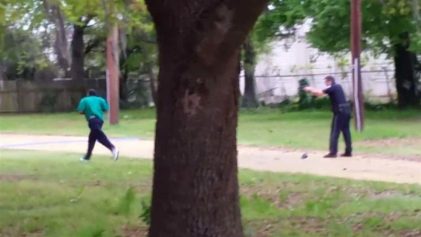
Footage of the April 2015 shooting that took place after a foot chase caused national outrage and contradicted Slager’s account of events.
At a virtual evidentiary hearing held on April 12 and 13, Slager testified that he only agreed to plead guilty in 2017 to a federal civil rights violation charge after Savage told him that the judge on the case, David Norton, said in January 2017 that he didn’t believe it was a murder case. Slager said Savage told him he wouldn’t receive significant prison time after the judge had made the comment.
Savage took Norton’s “not a murder case” quip to mean that the judge would rule the civil rights violation a manslaughter case, for which the upper end of the federal sentencing guidelines was eight years in prison, nearly four years less than the prosecution was offering in the deal. The plea deal stipulated a prison term between 12½ to 15½ years.
Slager told the appeals judge he was not heavily involved in his defense after his state murder trial ended in a mistrial in December 2016 when the jury was left deadlocked at an 11 to 1 vote for his conviction.
Slager first learned about the potential plea deal in August 2019 when Savage mentioned it after he and other members of the legal team came to visit him while the former officer was serving his sentence in Colorado.
But Gergel called the idea that Savage’s counsel was ineffective “ridiculous.”
The appeals judge added toward the end of last week’s testimony, “I’m not sure any defendant’s had a more vigorous and capable defense. … No matter how capable and creative the lawyer is, you can’t turn lemons into lemonade sometimes.”
“In the end, even a great lawyer could not overcome the video of Slager shooting nine times at a running man’s back and then lying about it,” Gergel added.
Because Norton found that Slager acted with malice, the door was opened to a murder finding, as opposed to manslaughter. Norton ultimately found that Slager was guilty of the equivalent of second-degree murder and sentenced him accordingly.
The day of the shooting, Slager pulled the 50-year-old Scott over for a broken taillight. Scott fled on foot before Slager deployed a Taser and two engaged in a struggle on the ground. Scott then got up and began running away from Slager, who fired nine shots, striking Scott five times in the back, and then walked over to his body and dropping the stun gun next to him. Scott was 15 feet away from the officer before he began firing.
Bystander cellphone footage captured the shooting but not what led to it. Before Slager learned there was a video of the encounter, he lied to investigators, saying Scott had stolen his Taser during the scuffle.
According to federal prison records, Slager will remain behind bars until 2033.