There was mounting pressure this week from the international community to end the conflict in Ethiopia’s Tigray region, a rebel stronghold in the nation’s northern province.
But Ethiopian Prime Minister Abiy Ahmed did not yield to the ramped up calls for de-escalation, telling the international community to “stand by” and allow Ethiopia to resolve the ongoing crisis internally.
In a statement Wednesday, Abiy rejected outside intervention telling peacekeepers to “refrain from any unwelcome and unlawful acts of interference.
“While we appreciate and understand the interest of the international community to assist in the ongoing law enforcement operations, we would also like to underscore that this must be done in accordance with international law,” Abiy wrote.
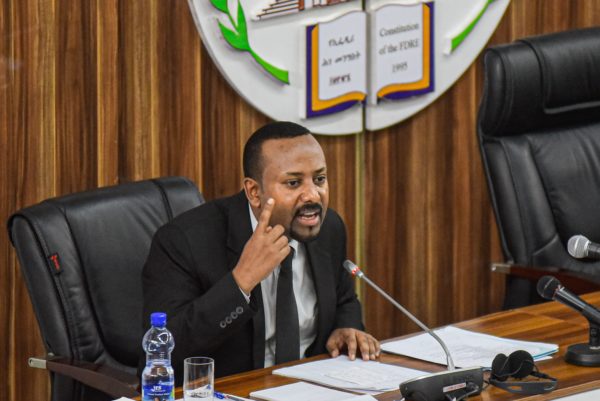
“As a sovereign state, Ethiopia has every right to uphold and enforce its laws within its own territory. And that is exactly what we are doing,” he later added.
On Friday, Abiy pledged to keep Tigrayan civilians safe while announcing the “final phase” of his government’s military offensive in the region, Reuters reported.
The Ethiopian army has been battling “junta forces” in Tigray’s capital city, Mekelle, since Nov. 4. Abiy ordered a military offensive after TPLF troops stormed the Northern Command, seizing control of the federal army base in Mekelle.
Tigray is a region of 6 million people. The clash there has inflamed the Horn of Africa, with collateral fallout spilling into Sudan and Eritrea, both nations that border Tigray. It’s also resulted in a humanitarian crisis and reports of an ethnic massacre. Aid routes have been cut off, more than 40,000 people have fled to neighboring Sudan, and rations for refugees are likely to not to last through the week, according to reports from United Nations officials.
To make matters worse, communication has been cut off to the region, making it virtually impossible to get a true assessment of what’s taking place on the ground, according to The Associated Press. A 72-hour surrender ultimatum was set to expire Wednesday.
Tanks were positioned Monday about 30 miles outside of Mekelle — a town of about 500,000 people — and federal forces surrounded the capital city, Reuters reported. Government officials warned residents to move away from TPLF leaders and military installations, saying there will be “no mercy,” AP reported. But there were concerns that civilians on the ground would not hear of the warning due to the communications blackout.
The Guardian reported that the leader of the Tigray People’s Liberation Front (TPLF), the region’s ruling party, said his troops were “ready to die” defending their homeland Tuesday. It was not immediately clear if TPLF had laid down arms or military forces had moved into the region by Wednesday.
“Warnings alone do not absolve the government of its duty to take constant care to protect civilians when carrying out military operations in urban areas that are home to thousands of people who may not be able to reach more secure areas,” Human Rights Watch’s Horn of Africa Director Laetitia Bader said in a statement.
U.N. Security Council members, in a closed-door meeting Tuesday, supported the notion of deploying three high-level envoys to Ethiopia as part of a diplomatic effort led by the African Union.
But Abiy made clear he has no interest in such efforts.
“Ethiopia appreciates the well-meaning concerns of our friends within the international community,” his statement read. “I would, however, like to stress the fact that Ethiopia is very much capable and willing to resolve this situation in accordance with its laws and its international obligations.”
Not only are fears of violence heightening, the crisis has overwhelmed humanitarian agencies. U.N. officials said agencies will be working through January to raise $76 million to provide relief for 2 million people in the Tigray, Afar and Amhara regions of northern Ethiopia.
In an afternoon briefing Tuesday, the U.N. said road blockages and communication blackouts continued to hinder humanitarian access to the war-ravaged territory.
Only about 8,000 of the refugees in Sudan had been relocated to designated settlement camps by Tuesday. Most are still staged in overcrowded checkpoints near the border, U.N. officials stated.
Supplies were expected to run out within a week at four camps in Tigray where nearly 100,000 Eritrean refugees are held. Eritreans have fled their repressive native land to shelter in Ethiopia long before the recent crisis unfolded there. Now they find themselves facing hardship in the country they turned to as a safe haven.
Despite scaling up their efforts, aid workers have been unable to deliver food, water and essential medicines to the displaced Eritrean refugees, who rely heavily on the humanitarian relief.
Jake Sullivan, President-elect Joe Biden’s national security advisor, weighed in on Twitter Wednesday morning as the concession deadline for Tigrayan forces loomed closer.
“I’m deeply concerned about the risk of violence against civilians, including potential war crimes, in the fighting around Mekelle in Ethiopia,” he wrote. “Civilians must be protected and humanitarian access must be opened. Both sides should immediately begin dialogue facilitated by the AU.”
A wave of anti-government protests propelled Abiy into his role as Ethiopia’s most powerful man in 2018. He supplanted a nearly 30-year regime during which Tigray played a leading role.
Abiy’s new central government butted heads with the regional government in Tigray — particularly the TPLF. Tigray officials angered the prime minister when they staged regional elections in September despite a federal order to postpone them due to COVID-19.
The tensions reached a boiling point on Nov. 4 when TPLF troops stormed the Northern Command, seizing control of the federal army base in Mekelle. Abiy responded by ordering a military offensive against the militia. Three weeks of fighting have ensued since.
In his statement Wednesday, Abiy described TPLF as “hardline members of the old order” who’ve threatened internal peace. He called their attack on the Northern Command “an act of treason” and said they have used force to destabilize his reform efforts in an attempt to thrust themselves back into the seat of power unconstitutionally.
The prime minister alleged the insurgency is to blame for the massacre of at least 600 civilians in Mai Kadra, a town in the Tigray region. A local youth group identified as Samri committed the killings Nov. 9 and 10 with help from police, local militiamen and other Tigrayan civilians, Al Jazeera reported. The Ethiopian Human Rights Commission, a commission appointed by the Ethiopian government, was sent in to investigate the massacre Nov. 14. EHRC said in a report on Tuesday the attackers targeted residents from the Amharas and Wolkait ethnic groups.


