Sarah Collins Rudolph is seeking restitution from the state of Alabama more than 50 years after she was injured by a church bombing that killed her sister and three other Black girls.
On Sept. 14, a group of lawyers from Jenner & Block LLP sent a letter to Alabama Gov. Kay Ivey requesting an apology and compensation for her ordeal. The law firm decided to represent Rudolph pro bono after a former partner heard her speak in South Carolina last year, according to The Washington Post.
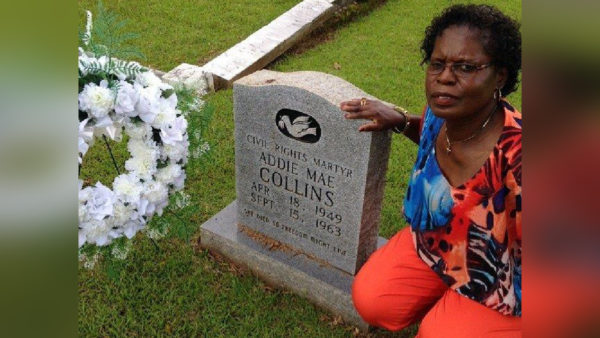
“On that morning, Ms. Collins Rudolph simply wanted to do what so many other little girls across Alabama were doing — attend a church service,” the letter read. “But instead of gaining the solace and celebration of prayer, the church was bombed by those affiliated with the Ku Klux Klan and our client lost her sister, her right eye, her childhood, and in ways she could never know then as a 12-year old girl, a lifetime’s worth of opportunities and dreams.”
On the morning of Sept. 15, 1963, 12-year-old Rudolph was standing in the basement of the 16th Street Baptist Church in Birmingham when dynamite blew a crater into the church. Rudolph survived the explosion, but her 14-year-old sister Addie Mae Collins was killed with their friends 11-year-old Denise McNair, Carole Robertson, and Cynthia Wesley, both 14.
Rudolph’s body was embedded with glass and she lost an eye. She was unable to attend her sister’s funeral because she was still in the hospital recovering from her injuries. At 69 years old, she still has glass in her remaining eye and emotional scars from that day. Her doctor is scared to touch it.
“He’s afraid that if something happens, I’ll go blind,” she told The New York Times.
No one was held accountable for the bombing until 1977, when Ku Klux Klansman Robert E. Chambliss was convicted for the murder of McNair. His accomplices, fellow Klan members Thomas E. Blanton Jr. and Bobby Frank Cherry, were not convicted until 2001 and 2002, respectively. All three died in prison.
The letter written by Rudolph’s legal team blames former Alabama Gov. George Wallace and other leaders for inciting the bigotry behind the bombing.
“While the State of Alabama did not place the bomb next to the church, its Governor and other leaders at the time played an undisputed role in encouraging its citizens to engage in racial violence, including the violence that stole the lives of four little girls and irreparably injured a fifth,” the letter states.
Rudolph’s lawyers requested compensation, but expressed a willingness to work with the governor’s office on the settlement. The letter included a draft of a resolution including an official apology.
“We would greatly value the opportunity to work with you and your office to see if justice, in the form of an official apology as well as compensation, can be achieved,” the lawyers wrote. “We know that in the past, Alabama has engaged in legislative action to issue an official apology, and we would like to explore a similar avenue for Ms. Collins Rudolph.”
In her interview with The New York Times, Rudolph revealed critics accused her of trying to capitalize on the movement sparked by the death of George Floyd. She has been working with Jenner & Block for over a year.
“I’ve heard people were saying that ‘She wants something just because George Floyd and them got money,’ but no, that wasn’t it,” Rudolph explained. “I’ve been trying for years.”
George Rudolph, her husband, believes an apology is long overdue.
“You should be safe in a church or in your own home,” he said. “Sarah never did get anything for what she went through.”


