Amid a pandemic, a civil rights reckoning, and the heat of the Los Angeles summer, three young brothers are helping to cool the place down with a hip-hop-inspired healthy frozen pop business that donates a portion of its proceeds to charity.
The brothers, 10-year-old Shiloh, 12-year-old Judah, and 14-year-old Nas Accius, started Jiggy Popp with the idea of introducing a healthy treat to their community. Through their all-natural-ingredient products, the boys aim to provide an accessible gateway to a vegan lifestyle while also giving back. Shiloh, Judah and Nas plan to donate a portion of their proceeds.
The boys’ musical backgrounds influenced their decision to donate their money to inner-city arts programs. The Fernando Pullum Arts Center in Leimert Park, where the boys often vend, is one of the chief recipients of nearly $6000 the boys have contributed so far.
“It’s not only about just having access to art programs, it’s beyond that. It’s more about having a creative mindset and creative solutions,” Judah explained. “But for that to happen, people need to be creative. That’s where the idea popped in: Why not give back to arts programs. They help children, so why not help them help children.”
Crediting music with enabling them to start their business in the first place, these lifelong musicians have infused their products with some hip-hop culture.
“Before, I was a street performer. I was bussing on the streets, I was playing my guitar,” explained eldest brother Nas. The money he earned there, matched by a gift from the trio’s dad, made up the $700 start-up cost for Jiggy Popp. Everything else, including the names of the pops, was the result of collaboration.
“The flavors for our pops are Black culture-related,” Judah explained. “We have things like Mango Unchained – Django Unchained – like the movie. We have Strawberry Better 23, like Strawberry Letter 23, which is a Prince song,” he pointed out. Other flavors like Georgia Peach on my Mind, Blackberry Gordy and Tropic Like it’s Hot are also a nod to Black culture.
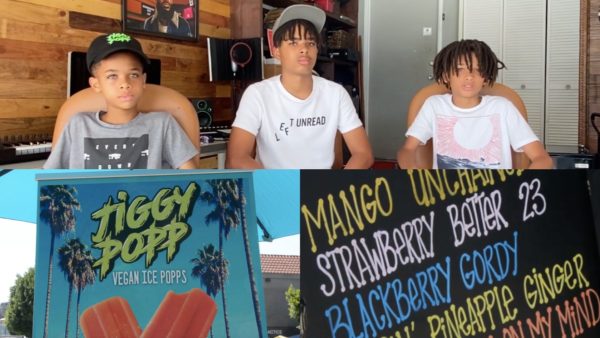
One expert says that what these young men are doing is not only important for development but vital for the Black community. Will Campbell, professor of Entrepreneurship at Southern University and VP of Commercial Services and Mortgage Retail at Essential Federal Credit Union, pointed out the alarming wealth gap between black and white families. “Entrepreneurship is the only way we’re going to make up the wealth gap.” He added, “Creating those entrepreneurs with very innovative, creative, and bright minds. Training that mindset at an early age will help them develop that financial responsibility. It teaches stewardship early.”
The boys understand and accept their collective responsibility. “When people buy our pops it’s not just about more money,” Judah said. “Most people we encounter are like ‘look at my young black kings out here hustling’. I feel like I’m inspiring people.”
Each boy has hopes for the future of their business and their community. Shiloh hopes the business will grow and people will share it with their friends. Nas can’t help but think about a potential reality — that they may never have to work a 9 to 5. “Once this is fully sustainable, this could be our life,” he said. “If I had to say what we wanted to do when we grow up, it’s this business.”
Meanwhile, Judah hopes to continue to inspire people. “Every other kid could do this as well,” he pointed out. “I want to inspire people to be able to do what we do: Have their own company and thrive the way that we have. Moving forward I want to keep inspiring people.”


