Seattle Police Department chief Carmen Best announced plans to retire early after the City Council members voted to defund the force.
Best announced her intentions on Monday, Aug. 10, in a letter to her staff.
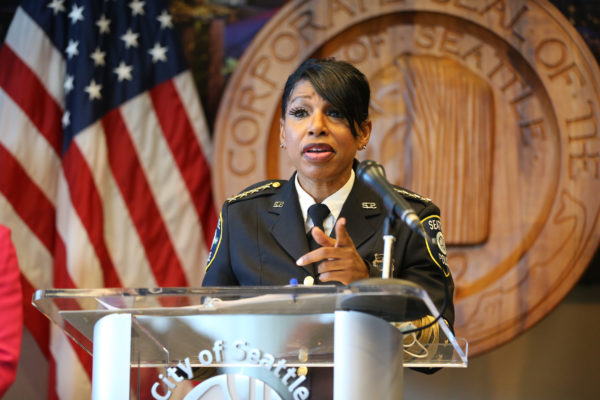
“This was a difficult decision for me but when it’s time, it’s time,” Best wrote. Her departure came after the city council voted to strip 14 percent of the police department’s budget.
The move will take $4 million out of the 2019 to 2020 budget and culminate to an $11 million loss over the course of a year. In the mid-year budget cut, Best’s salary will take a hit and 32 officers are expected to be taken off patrol. There were advocates pushing for a 50 percent decrease on the $400 million budget, but it did not pan out.
Best will be chief until Sept. 2 and Deputy Chief Adrian Diaz will serve as interim police chief. The past few weeks have been turbulent for SPD due to the unrest over the number of high-profile deaths of Black people caused by law enforcement and vigilantes. The department was criticized for using tear gas and other non-lethal crowd control methods during recent protests.
Although Best did not explain her reason for quitting in her letter, she was open about her feelings during a news briefing on Tuesday, per The Associated Press. The chief insisted her retirement “is not about the money, and it certainly isn’t about the demonstrators.”
“I mean, be real, I have a lot thicker skin than that,” Best continued. “It really is about the overarching lack of respect for the officers, the men and women who work so hard, day in and day out.”
She admitted the defunding of her department upset her.
“The idea that we’ve worked so incredibly hard to make sure our department was diverse, that (it) reflects the community that we serve, to just turn that all on a dime and hack it off, without having a plan in place to move forward, is highly distressful for me,” Best told reporters.
Even though she is at odds with the city council, Best has an ally in Mayor Jenny Durkan. In the letter, she thanked the mayor for “her continuous support through good times and tough times.”
The feeling is mutual and Durkan heaped praises on the chief in a response to her resignation letter.
“Carmen Best is still devoted to this department and our city,” Durkan wrote. “I regret deeply that she concluded that the best way to serve the city and help the department was a change in leadership, in the hope that would change the dynamics to move forward with the City Council.”
A weepy Durkan called Best’s departure a “deep loss for our city” during a news conference on Tuesday.
“My heart is obviously heavy to lose her,” Durkan said. “And I will freely admit, I wish she was staying.”


