
The general public didn’t know it then, but when Iowa State guard Rasir Bolton transferred from Penn State last year, it wasn’t because he wasn’t getting enough playing time or didn’t like the campus. It had to do with a racist comment that was made by his former coach.
Bolton, a junior, sent a tweet on Monday, July 6, and said the head coach of Penn State’s men’s basketball team Patrick Chambers told him that he had a noose around his neck.
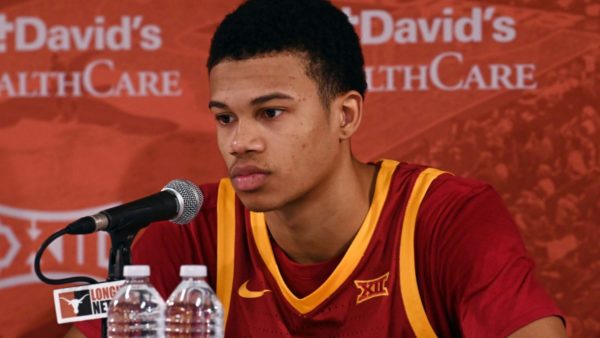
The remark was made one day after Chambers served a one-game suspension for pushing Penn State guard Myles Dread during a game against Michigan last year.
“A ‘noose’ around my neck is why I left Penn State,” Bolton wrote in his message. “Head coach Patrick Chambers, the day after his one-game suspension in January 2019, in talking to me referenced a ‘noose’ around my neck.”
He added, “A noose, symbolic of lynching, defined as one of the most powerful symbols directed at African Americans invoking the history of lynching, slavery and racial terrorism. Due to other interactions with Coach, I knew this was no slip of the tongue.”

Bolton then detailed what took place after the noose comment was made, which involved speaking to Chambers and the athletic department about it.
The Virginia-raised point guard also told his parents, who contacted Penn State’s athletic department by phone and in writing. His folks eventually took a five-hour drive to Penn State to meet with the athletic department and Chambers more than once.
Chambers admitted to making the comment in one of those meetings. Still, Bolton said he didn’t find that Penn State did enough to assist him.
“I was provided one meeting and a phone number to text with a psychologist,” wrote Bolton. “I was taught ways to deal with Coach Chambers’ personality type … Coach Chambers told me he was ‘really impressed with how well spoken and organized my parents were.’ Yet, another subtle insult.”
Bolton said he was told by his teammates that he couldn’t be trusted after reporting Chambers, which was another personal blow.
“Surface level resources are not good enough. In most cases it is the Coach who is protected, while the player is left to deal with it or leave,” wrote Bolton.
Chambers released a statement on Twitter Monday, July 6, and he finally apologized to Bolton and his family.
“I failed to comprehend the experiences of others and the reference I made was hurtful, insensitive and unacceptable,” wrote Chambers. “I cannot apologize enough for what I said, and I will carry that forever.”
“It is critically important for me to recognize my responsibility in better understanding the experiences of others and I am committed to doing the necessary work required to do just that,” he added.

Bolton’s message comes at a time when individuals and institutions, including colleges and universities, are being called out for past treatment of Black people.
Last month, three athletes at Liberty University in Lynchburg, Virginia, entered the transfer pool after school president Jerry Falwell Jr. tweeted a photo of someone in blackface and another dressed in Ku Klux Klan attire.
Asia Todd, formerly a guard for Liberty University’s women’s basketball team, said she was transferring because of Falwell’s tweet, as did Tayvion Land and Kei’Trel Clark, who both had played for the football team.


