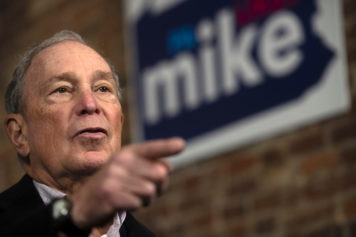
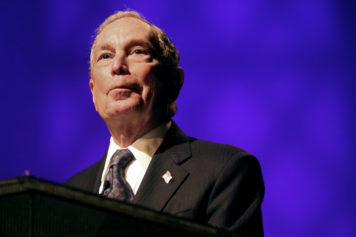
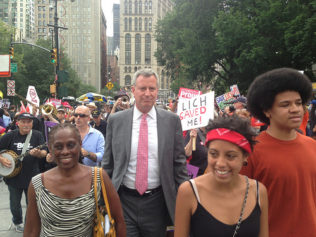
Michael Bloomberg‘s visit to a historically-Black church in Selma, Alabama, didn’t go as planned as several congregants stood up and turned their backs in protest of the presidential hopeful.
Bloomberg, who’s been trying desperately to woo African-American voters, addressed parishioners at Brown Chapel AME Church early Sunday, where dozens gathered to commemorate the 55th anniversary of “Bloody Sunday.” The former New York City mayor received the not-so-warm welcome as he spoke about the racial injustice faced by Black Americans.
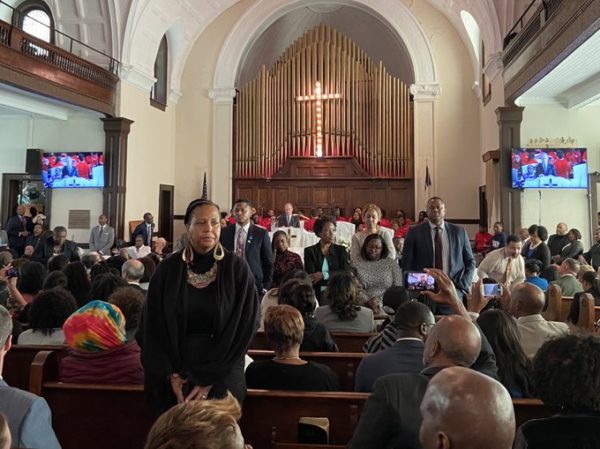
Photos and video shared to social media showed worshipers standing defiantly with their backs turned as an expressionless Bloomberg, 78, stared ahead.
In his introduction of the billionaire businessman, church pastor Rev. Leodis Strong noted that Bloomberg initially declined the invitation to speak because he was too busy campaigning to beat Donald Trump.
“‘I was hurt, I was disappointed,” Strong said, according to local outlet CBS 58. He added, after giving it a second thought, Bloomberg agreed to come and speak.
“I think it’s important that he came, and it shows a willingness on his part to change,” Strong said, addressing the congregation and commending the ex-mayor for showing up. “And I like that. And I think that is important. And I want to thank him for coming, for being here.”
Bloomberg took the stage soon after and discussed several issues, including voter suppression, economic justice and criminal justice reform. Bloomberg has faced tough criticism over his support of stop-and-frisk policing, which disproportionately targeted Black and Hispanic citizens, during his time as NYC mayor. However, he said he hopes to address racial inequality with his newly proposed Greenwood Initiative.
“Dr. King understood that the right to vote was only the first step in the march to true equality because true equality means that wealth in this country should have no relation to race or ethnicity. That is what my Greenwood Initiative is all about,” Bloomberg told the crowd.
He recalled the 1921 Tulsa Race Massacre, noting that up until a year go he was totally unaware of it “like so many other Americans.”
“It was one of the worst tragedies in American history,” the Democratic candidate added, as reported by The Hill. “But sadly, it was just another instance of black families being systematically robbed and exploited. In today’s reading from [the book of] Isaiah, ‘do right, seek justice and defend the oppressed’ was the call to action. That’s what our Greenwood Initiative resolves to do.”
By the end of Bloomberg’s speech, however, nearly a dozen people had their backs turned to him.
The billionaire businessman was joined by fellow Democrats Joe Biden, Sen. Elizabeth Warren and ex-Georgia gubernatorial candidate Stacey Abrams for the gathering at the Selma church to commemorate the 55th anniversary of “Bloody Sunday,” in which dozens of civil rights activists were beaten and attacked with tear gas by Alabama state troopers as they marched from Selma to the state capitol in Montgomery via the Edmund Pettus Bridge in March 1965.
The violent confrontation was the first of three marches from Selma to Montgomery in support of voting rights. The marches would serve as catalysts for the passage of the Voting Rights Act later that year.
Civil rights champion Rep. John Lewis, who was just 17 years old when he suffered a brutal beating by officers in the 1965 demonstration, delivered a stirring message to voters Sunday from the very bridge where he and many others were attacked some 55 years earlier.
“We were beaten, we were tear-gassed. I thought I was going to die on this bridge,” the Georgia congressman, who’s battling an advanced form of pancreatic cancer, told the crowd. “But somehow and some way, God almighty helped me here. We must go out and vote like we never, ever voted before.”