Social media has erupted over a newly unveiled tidbit disclosed by the screenwriter of the recently-opened film “Harriet.” According to Gregory Allen Howard, a studio executive suggested in 1994 that the Black enslaved abolitionist Harriet Tubman be portrayed on-screen by “The Pelican Brief” star Julia Roberts.
“When I got in the business, I wanted to tell these historical stories by turning them into entertainment. I didn’t want to give history lessons,” writer/producer Howard said in a Nov. 1 Q&A for the film’s distributor Focus Features. “I wanted to turn Harriet Tubman’s life, which I’d studied in college, into an action-adventure movie. The climate in Hollywood, however, was very different back then. I was told how one studio head said in a meeting, ‘This script is fantastic. Let’s get Julia Roberts to play Harriet Tubman.’ When someone pointed out that Roberts couldn’t be Harriet, the executive responded, ‘It was so long ago. No one is going to know the difference.'”
In an essay for the Los Angeles Times published on Tuesday morning, Howard expounded further that it was “a single black person in that studio meeting 25 years ago” to inform the former president of a studio sublabel “that Harriet Tubman was a black woman. The president replied, ‘That was so long ago. No one will know that.’”
British actress Cynthia Erivo ultimately wound up starring as Tubman in the drama released in theaters on Nov. 1.
But Howard’s revelation spurred a fierce reaction online as movie-goers tried to wrap their heads around the matter.
“Take several seats!!!!! TF is wrong with Hollywood?? Oh yea NVM 😒”
“What?? 🥴 Is that screenwriter on crack or something? 🤦🏼♀️”
“That’s disrespectful to our history”
“That’s what wrong with society ..seriously ..Gabriele Union will do a great job , Gazelle Beauvais too . Give them a chance ..jeez”
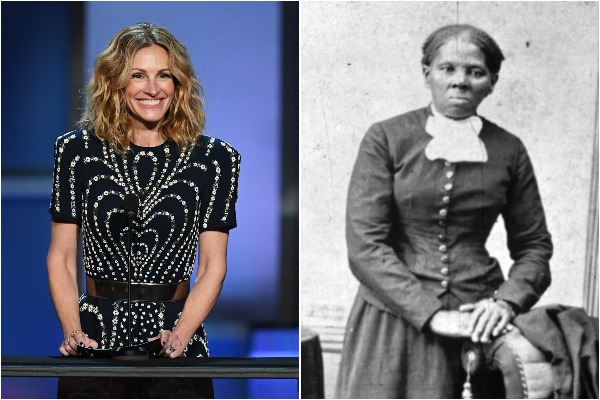
It’s not clear how the studio exec would have wanted Roberts, who has not commented publicly on Howard’s anecdote, to pull off the performance. But Hollywood has made controversy-inducing casting choices before.
In 2013, reports emerged that Zoe Saldana was tapped to portray legendary singer and activist Nina Simone. Saldana, an Afro-Latina actress hailing from the Dominican Republic, was criticized for taking on the role as a light-skinned woman with a small nose and average-sized lips. Simone, meanwhile, had characteristically Afro-centric features, including a wide-set nose and full lips. She was also dark-skinned. The backlash over Saldana’s casting was so severe that a petition was launched for her role to be re-cast.
However, the actress defended her part in the film, saying to Glam Belleza “I do wish that people made their own judgment after they watch the movie because right now, it isn’t even edited yet, and there’s been so much uproar. … But the one thing that we all have in common is an unconditional love and admiration and respect for Nina Simone. Something that’s done out of love, in my mind, can’t be right or wrong.”
The film went on to be completed and released in 2016 with Saldana using prosthetics and makeup to make her performance complete.