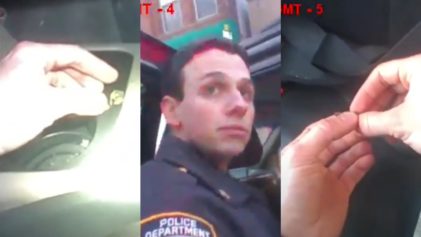
The Staten Island police commander who oversaw the events that led to the tragic death of Eric Garner in 2014 texted an officer that the death was “no big deal,” according to a New York Times report.
The texts between commander Lt. Christopher Bannon and Sgt. Dhanan Saminath were revealed for the first time Thursday during the disciplinary hearing for accused officer Daniel Pantaleo, who faces termination for his reckless use of a chokehold that lead to Garner’s death.
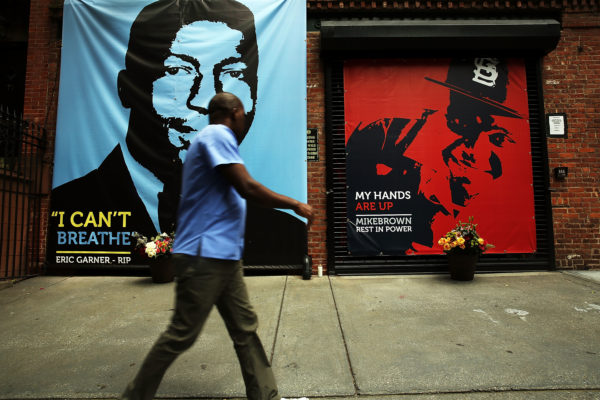
Eric Garner suffered a heart attack after police attempted to arrest him for selling loose, untaxed cigarettes. His last words, “I can’t breathe” became a rallying cry for the Black Lives Matter movement. (Photo by Spencer Platt/Getty Images)
Pantaleo arrested the Staten Island man in July 2014 on suspicion that he was selling loose, untaxed cigarettes on the street. The incident, caught on video, showed the officer take Garner, 44, to the ground and place him in the department-banned maneuver.
Garner’s last words, “I can’t breathe,” became a rallying cry for the Black Lives Matter movement and their fight against police brutality.
On July 17, 2014, Bannon received a text message from Saminath alerting him to the arrest gone wrong. The sergeant told Bannon that the suspect, later identified as Garner, had been wrestled to the ground.
“When they took him down, Eric went into cardiac arrest. He’s likely DOA (dead on arrival),” Saminath texted, adding that Garner didn’t have a pulse.
“Not a big deal,” the lieutenant wrote back. “We were effecting a lawful arrest.”
The New York Times reported that the texts drew gasps from the courtroom as they were read aloud.
Garner, a father-of-six suffered a heart attack in the incident and later died. An autopsy by the city’s medical examiner determined that the choke hold, along with Garner’s poor health — asthma, high blood pressure, diabetes — had contributed to his death. That same medical examiner took the stand Thursday and testified that the banned maneuver “set into motion a lethal sequence” that led to Garner’s demise.
A grand jury declined to indict Pantaleo on criminal charges in the incident in 2014, sparking nights of protest across the city. A civil rights inquiry was launched, but charges have yet to be filed. The statute of limitations expires in July, on the five year anniversary of Garner’s arrest.
The city awarded Garner’s family a $5.9 million wrongful death settlement in 2015.
In trying to explain the damning texts, Bannon insisted he meant no harm by what he said.
“My reasoning,’’ the lieutenant said, “was not to be malicious. It’s to make sure the officer knew he was put in a bad situation.”
Prosecutor Suzanne O’Hare pressed Bannon on the issue, asking: “Would you agree that Eric Garner was put in a bad situation?”
“I don’t know how to answer that,” he replied after a long pause.
Bannon’s explanation only angered Gwen Carr, Garner’s mother.
“No big deal?” Carr angrily told reporters after the hearing in Lower Manhattan. “If one of his loved ones was on the ground dead and someone came up to him and said, ‘It’s no big deal,’ how would you feel about it?”
Thursdays’s hearing also focused on low-level “quality of life” policing that officers were conducting in the weeks before Garner’s death, according to the Times. This enforcement, better known as “broken windows policing,” tends to target Blacks and other racial minorities. Police said Garner had been arrested twice during that crackdown, the third on the day he died.
“The arrest of Eric Garner was the result of a chain of decisions originating at the very highest levels of the N.Y.P.D.,” Patrick J. Lynch, the president of the Police Benevolent Association, told reporters after the hearing. “Police officers who enforce quality of life offenses are not cowboys or free agents — they follow the direction of their supervisors, who are in turn responding to complaints from the community.”
Pantaleo’s supervisors also took the stand and described the accused cop as an outstanding officer.
“On a scale of 0 to 5, he was a 5.0,” Bannon told the court. “Officer Pantaleo was one of the best officers I’ve supervised.’’
Pantaleo faces NYPD administrative charges of reckless use of force and strangulation. If found guilty, he could face punishment ranging from the loss of vacation days to termination.