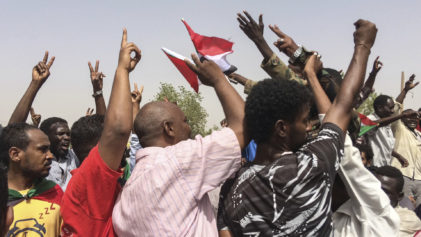
CAIRO (AP) — Sudanese protesters on Monday welcomed the “positive steps” taken by the ruling military council, which held talks with opposition leaders over the weekend and released some political prisoners.
The praise came despite a brief incident earlier Monday in which activists said soldiers attempted to disperse the ongoing protest sit-in outside the military headquarters in the capital, Khartoum, but eventually backed off.
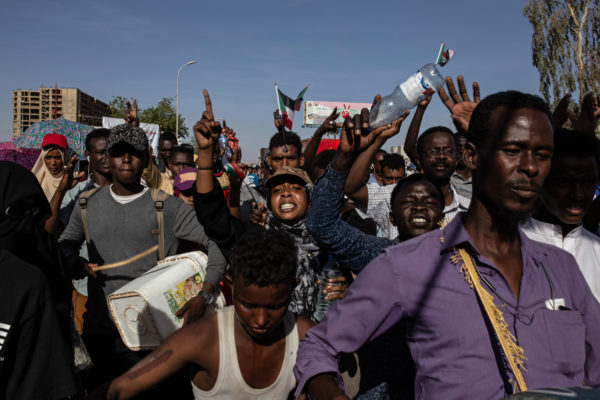
Last week, Sudan’s military ousted longtime President Omar al-Bashir following four months of street protests against his rule, then appointed a military council that it says will rule for two years or less while elections are organized. Demonstrators fear that the army, dominated by al-Bashir appointees, will cling to power or select one of its own to succeed him.
The Sudanese Professionals Association, which is behind the protests, repeated its key demand at a press conference in Khartoum, saying the military must immediately give power to a transitional civilian government that would rule for four years.
“The trust is in the street,” said prominent activist Mohammed Naji al-Asam, referring to the ongoing sit-in. The SPA also called on the international community to support civilian rule.
The African Union meanwhile gave Sudan’s military 15 days to hand over power to a “civilian-led political authority” or face suspension from the union’s activities. It said a civilian authority should hold elections “as quickly as possible.”
Earlier in the day, the SPA urged people into the streets, saying “There is an attempt to break up the sit-in. We appeal to everyone to head to the area to protect your revolution and gains.”
There were no clashes and no one was hurt in the attempted dispersal, but the incident renewed concerns that the military could renege on its promises not to use force against the peaceful demonstrators. Previous attempts to break up the sit-in before al-Bashir’s ouster last Thursday killed dozens of people.
Videos circulated online showing hundreds of troops outside the military compound in Khartoum. In the footage, an officer is heard saying they came to open roads, “clean the area” and remove the barricades set up by the protesters to protect their gathering.
Some protesters are then seen in the footage sitting down on the ground in front of the soldiers, who subsequently move away. In some videos the protesters chant “Revolution,” as well as slogans against al-Bashir’s Islamist supporters. Protester Nourhan Mostafa said the sit-in will continue until “the demands the Sudanese revolution are met.”
Also Monday, Gen. Abdel-Fattah Burhan, the head of the transitional military council, announced an overhaul of the military leadership and appointed a new chief of staff, according to a military statement.
The statement said Gen. Hashem Babakr was appointed the joint chief of staff, replacing Gen. Kamal Abdel-Marouf al-Mahi, who was ousted along with Defense Minister Awad ibn Ouf a day after al-Bashir’s overthrow.
Babakr, 63, was appointed by al-Bashir as chairman of the joint operations authority in February.
Since his ouster, al-Bashir — president for nearly 30 years — has been under house arrest in Khartoum. The military said he was removed from power in response to the demands of the people.
A military spokesman said Sunday it will name a civilian prime minister and Cabinet — but not a president — to help govern the country. The announcement was unlikely to satisfy the protesters. Lt. Gen. Shamseldin Kibashi said in televised remarks that the military had begun to overhaul the security apparatus and wouldn’t break up the demonstrations outside the military headquarters.
The U.S., Britain and Norway on Sunday urged the military authorities to “listen to the calls from the Sudanese people.”
Sudan’s uprising began in December as a series of protests against the rising costs of fuel and food, but soon shifted to calls for al-Bashir to step down. Dozens of people were killed in a security crackdown aimed at quashing the protests.
The protests against al-Bashir gained further momentum after Algeria’s President Abdelaziz Bouteflika, in power for 20 years, resigned earlier this month in response to weeks of similar protests.