After a heated debate and even a little shouting, the Illinois House of Representatives voted in favor of a bill requiring all publicly held companies whose headquarters are in the state to have a minimum of one woman and one African-American on the company’s corporate board.
State Rep. Emanuel “Chris” Welch’s (D-Ill.) bill, which passed the House on Friday, would give companies until 2021 to meet the requirements of the new measure.
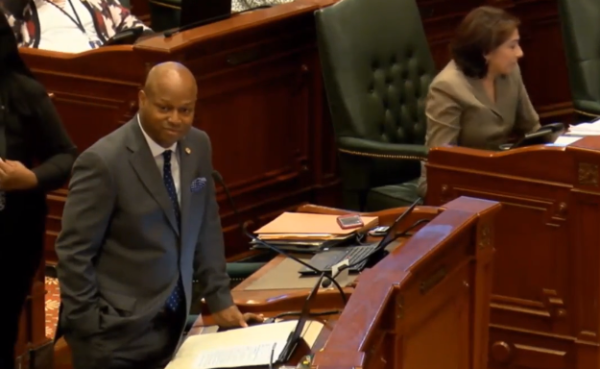
Rep. Chris Welch argued that woman and Black Americans deserve to have a voice in corporate America. (Image courtesy of Illinois News Network / video screenshot)
“No later than the close of the 2020 calendar year, a publicly held domestic or foreign corporation whose principal executive offices, according to the corporation’s SEC 10-K form, are located in Illinois shall have a minimum of one female director and one African American director on its board of directors,” the legislation reads.
“A corporation may increase the number of directors on its board to comply with this Section,” it continues.
Companies that refuse to comply with the bill, however, could face fines of up to $300,000. Under the terms, the secretary of state would also be required to keep an online record of corporations showing if they’re in compliance with the law or not.
California passed similar legislation last summer requiring publicly traded companies to appoint at least one woman to its board of directors. That bill didn’t include requirements for minorities, however.
Republican Rep. Tony McCombie blasted the Illinois bill as yet another piece of “anti-business” legislation lawmakers have approved this year.
“We are destroying the ability for our state to grow,” McCombie said, according to the Illinois News Service.
At one point, discourse over the bill became heated and accusations of racism were made, the news site reported. Friday’s debate also included talks of expanding the legislation to includes other racial minorities. Before the vote, Welch emphasized to his colleagues that Black Americans and women deserve to have a voice in corporate America, which he said they are currently being denied.
“I am not going to be ashamed to stand here and fight for the people that sent me here,” the lawmaker said. “Ashamed to fight for African-Americans to have a right in a room? Are you kidding me?”
The bill is now headed to the state Senate for consideration.