MINNEAPOLIS (AP) — Jury selection is scheduled to begin Monday in the trial of a former Minneapolis police officer who fatally shot an unarmed Australian woman after she called 911 to report a possible sexual assault behind her home.
Mohamed Noor, 33, is charged in the July 2017 death of Justine Ruszczyk Damond in a case that drew international attention, cost the police chief her job and forced major revisions to the police department’s policy on body cameras.
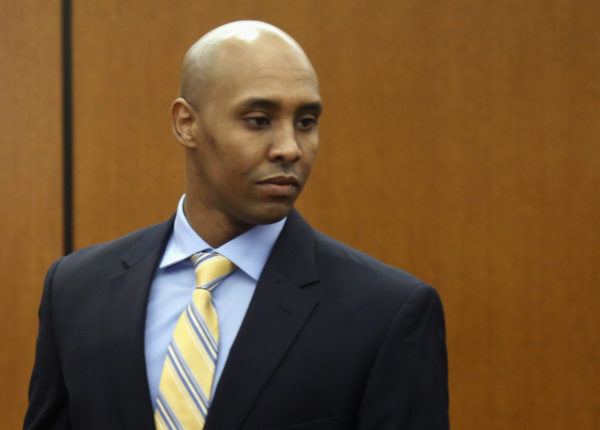
FILE – In this May 8, 2018, file photo, Mohamed Noor arrives at the Hennepin County Government Center for a hearing in Minneapolis. (AP Photo/Jim Mone, File)
Prosecutors charged Noor with second-degree intentional murder, third-degree murder and second-degree manslaughter, saying there is no evidence Noor faced a threat that justified deadly force.
They must prove he acted unreasonably when he shot Damond, a 40-year-old life coach and dual Australian-American citizen who was engaged to be married. Noor’s attorneys plan to argue that he used reasonable force and acted in self-defense.
Noor has refused to talk to investigators and his attorneys haven’t said whether he’ll testify at his trial, which could last weeks. On Monday, potential jurors will gather to receive instructions as the selection process begins.
Noor’s partner that night, Officer Matthew Harrity, told investigators he was driving a police sport utility vehicle when he heard a voice and a thump and caught a glimpse of someone outside his window. Harrity said he was startled and thought his life was in danger. He said he then heard a noise and turned to see that Noor, in the passenger seat, had fired his gun past Harrity and hit Damond through the driver’s-side window.
The officers did not turn on their body cameras until after the shooting, and there was no squad camera video.
The lack of video was widely criticized and Damond’s family called for changes, including when officers are required to turn on their cameras. Days later, the police department strengthened its policy to require that the cameras be activated immediately when responding to a call or making a traffic stop.
The shooting also raised questions about the training of Noor, a Somali-American whose arrival on the force about two years earlier had been celebrated by city leaders and Minnesota’s large Somali community. Noor had previously worked in property management.
Then-Chief Janee Harteau defended Noor’s training and said he was suited to be on the street. But Harteau was forced to resign by then-Mayor Betsy Hodges, who also lost her bid for re-election four months later in a race influenced by police-community relations.
Documents later filed as part of the criminal case showed that training officers voiced concerns about Noor’s fitness for duty long before he shot Damond, but he was deemed fit to serve.
Judge Kathryn Quaintance ruled that prosecutors cannot present evidence about prior “bad acts” as a police officer.
She also said Noor’s pre-employment psychological exam, which found that Noor was more likely than other officers to be impatient or have difficulty confronting people, cannot be used unless he testifies and it becomes relevant. She also ruled his refusal to speak to investigators can’t be used as evidence unless Noor takes the stand.