ATLANTA (AP) — Atlanta’s mayor and police chief are leading a push to re-examine evidence from a string of murders that terrorized the city’s black community between 1979 and 1981.
Mayor Keisha Lance Bottoms and Police Chief Erika Shields announced Thursday that the Georgia Bureau of Investigation and Fulton County District Attorney will review evidence in the “Atlanta Child Murders” cases to see if any of it can be tested further.
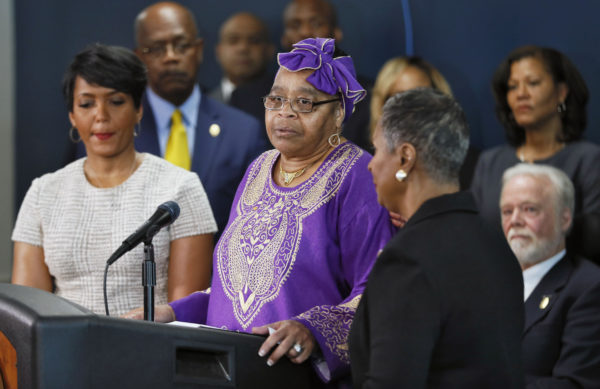
Catherine Leach-Bell, whose son, 13-year-old Curtis Walker, was among the victims, pleaded for closure. Atlanta Mayor Keisha Lance Bottoms announced Thursday that officials will take a fresh look at the Atlanta Child Murders cases that left more than 20 youths and young adults dead four decades ago. (Bob Andres/Atlanta Journal-Constitution via AP)
Wayne Williams was given two life sentences in 1982 for convictions in the deaths of two adults, thought to be among 29 black children and young adults — mostly boys — who were killed.
During his trial, prosecutors offered “pattern” evidence of 10 other murders he was not charged in. After Williams’ conviction, police closed 22 of the cases, blaming them on Williams without formally charging him. Some other cases remain formally unresolved.
Bottoms said she was hopeful that technological advancements and newly available genetic databases could turn up new information. The review comes as several high-profile cold cases across the country have been solved after comparing old DNA samples to publically available ancestry testing databases.
“There may not be any evidence available that can be re-examined. But we are taking the necessary steps to formally say that we are going to open up every box and look in every corner and see what we have left,” Bottoms said.
“I don’t think it’s any secret that, for many people, there’ve been questions as to whether or not Wayne Williams was responsible for all of the murders,” Bottoms later added.
Catherine Leach, whose teenage son Curtis Walker was among those murdered, said she is still seeking closure.
“His case is still sitting on the shelf, getting dusty and rusty until you can’t see the page,” Leach said. “I want some closure. I want some justice.”
Bottoms made the announcement just days ahead of the release of a documentary about the murders by filmmaker Will Packer on the Investigation Discovery channel.