
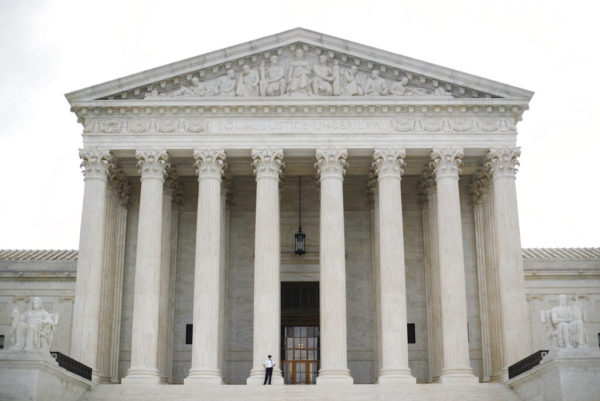
In this Oct. 9, 2018 photo, police office guards the main entrance to the Supreme Court in Washington. (AP Photo/Pablo Martinez Monsivais)
WASHINGTON (AP) — The Supreme Court ruled unanimously Wednesday that the Constitution’s ban on excessive fines applies to the states, an outcome that could help efforts to rein in police seizure of property from criminal suspects.
Justice Ruth Bader Ginsburg wrote the court’s opinion in favor of Tyson Timbs, of Marion, Indiana. Police seized Timbs’ $40,000 Land Rover when they arrested him for selling about $400 worth of heroin.
Reading a summary of her opinion in the courtroom, Ginsburg noted that governments employ fines “out of accord with the penal goals of retribution and deterrence” because fines are a source of revenue. The 85-year-old justice missed arguments last month following lung cancer surgery, but returned to the bench on Tuesday.
Timbs pleaded guilty, but faced no prison time. The biggest loss was the Land Rover he bought with some of the life insurance money he received after his father died.
Timbs still has to win one more round in court before he gets his vehicle back, but that seems to be a formality. A judge ruled that taking the car was disproportionate to the severity of the crime, which carries a maximum fine of $10,000. But Indiana’s top court said the justices had never ruled that the Eighth Amendment’s ban on excessive fines — like much of the rest of the Bill of Rights — applies to states as well as the federal government.
The case drew interest from liberal groups concerned about police abuses and conservative organizations opposed to excessive regulation. Timbs was represented by the libertarian public interest law firm Institute for Justice.
Law enforcement authorities have dramatically increased their use of civil forfeiture in recent decades. When law enforcement seizes the property of people accused of crimes, the proceeds from its sale often go directly to the agency that took it, Institute for Justice lawyer Wesley Hottot said in his written arguments in support of Timbs.
“For ordinary citizens, the real-world consequences can be devastating,” Hottot said.
The case is Timbs v. Indiana, 17-1091.


