PHOENIX (AP) — Amberkatherine DeCory carried photos of her daughter’s birth certificate in her diaper bag in case she had to prove that the lighter-skinned girl was really hers. Cydnee Rafferty gives her husband a letter explaining that he has permission to travel with their 5-year-old biracial daughter.
Families like theirs were not surprised when they heard what Meghan McCain‘s mother Cindy McCain had done. Cindy, also the widow of Sen. John McCain, reported a woman to police for possible human trafficking because she saw her at the airport with a toddler of a different ethnicity. Officers investigated and found no evidence of wrongdoing.
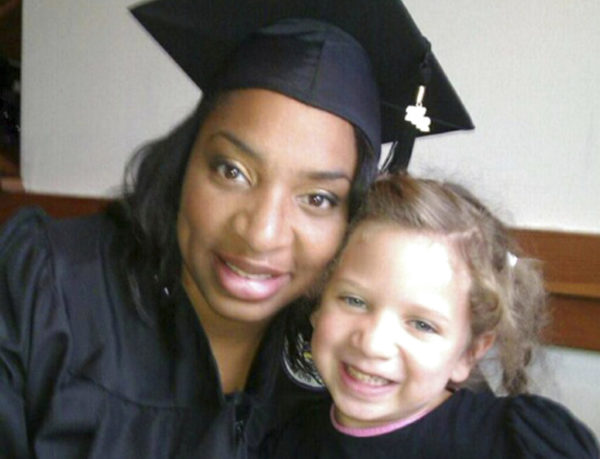
This undated selfie shows Amberkatherine DeCory with her daughter, Mila DeCory. (Amberkatherine DeCory via AP)
Parents whose children have a different complexion say they regularly face suspicion and the assumption that they must be watching someone else’s kids.
“This is a problem that, to be frank, well-meaning white people get themselves into,” said Rafferty, who is African-American and whose husband is white. “They think, ‘If it doesn’t make sense to me it must not be right.”
After McCain’s report, Rafferty posted to Twitter a selfie of her with her two children, ages 5 and 5 months.
“I know they don’t look like me, but I assure you, I grew them in my belly,” Rafferty wrote to McCain.
Earlier this month, McCain claimed on Phoenix radio station KTAR that the woman was waiting for a man who bought the child to get off a plane and that her Jan. 30 report to police had stopped the trafficking. She urged people to speak up if they see anything odd.
“I came in from a trip I’d been on,” McCain said. “I spotted — it looked odd — it was a woman of a different ethnicity than the child, this little toddler she had. Something didn’t click with me. I tell people ‘trust your gut.'”
She said she spoke about her suspicions with police “and they went over and questioned her. And, by God, she was trafficking that kid.”
Phoenix Police Sgt. Armando Carbajal confirmed that McCain requested a welfare check on a child at the airport, but said officers found “no evidence of criminal conduct or child endangerment.”
McCain has declined interview requests and has not said if anything besides the difference in ethnicity led her to suspect trafficking. A spokesman for the McCain Institute for International Leadership at Arizona State University said McCain was “only thinking about the possible ramifications of a criminal act, not the ethnicity of the possible trafficker.”
After police debunked her claim, McCain reiterated the importance of speaking up when something looks wrong.
“I apologize if anything else I have said on this matter distracts from ‘if you see something, say something,'” she wrote on Twitter.
Rafferty, a 38-year-old New Yorker, was surprised that McCain, who adopted a daughter from Bangladesh, would make the same something’s-not-right assumption that mixed-race families grapple with constantly. It’s not always summoning the police. Other, more common ways of calling out the differences sting too.
For Rafferty, the questions are frustrating and offensive: “Whose baby is that?” from a woman in the grocery store. “Where’s her beautiful golden skin and curly hair?” from a client at the office, who had a distinct idea of how a biracial child should look. “You’re the …?” followed by a pause for her to fill in the blank with “mom.”
And if she pushes a stroller on Manhattan’s Upper West Side, everyone assumes she’s the nanny. At the park, neither the mothers nor the caregivers know whether to embrace her in their camp.
DeCory, a 38-year-old police officer outside Minneapolis who has African-American and Native American ancestry, said the anxiety between mom and baby is a constant challenge for mixed-race families that isn’t talked about enough.
She recalls being haunted by a terrifying vision she couldn’t shake: Someone would question whether she was truly the mother of her daughter, and she wouldn’t be able to prove it. She’d imagine her daughter, Mila, being placed between her and a white woman while someone in authority watched to see which way she crawled.
Until her daughter could speak, DeCory carried her birth certificate and even a photo of her giving birth, just in case she had to prove that her light-haired, blue-eyed child was truly her own. As Mila has gotten older, her hair has darkened. She’s now 11.
DeCory didn’t face the same anxieties with her other two children, who have darker skin closer to her own.
“I would get anxiety going out with her in public,” DeCory said. “I was very reluctant to breastfeed her in public or do anything that would draw attention to me.”
Associated Press contributed to this story.


