A woman who is just one semester away from obtaining her law degree had an emotional reunion with the Superior Court judge who took a chance on her more than a decade ago.
Carmen Day is currently studying at Rutgers Law School in Camden, New Jersey, but she recently visited Charles Dortch’s courtroom among a small group of others on Jan. 7.
“I’ve waited for this moment for so long … for the chance to say thank you for believing in that lost girl so many years ago…and to show him that I made good on my promise,” she wrote on an Instagram post shared by Rutgers Law on Jan. 8. “It was a very emotional reunion for us both and I am so grateful to God for allowing me to see this day. After meeting in his chambers, he took me out to the courtroom and shared my story — now our story.”
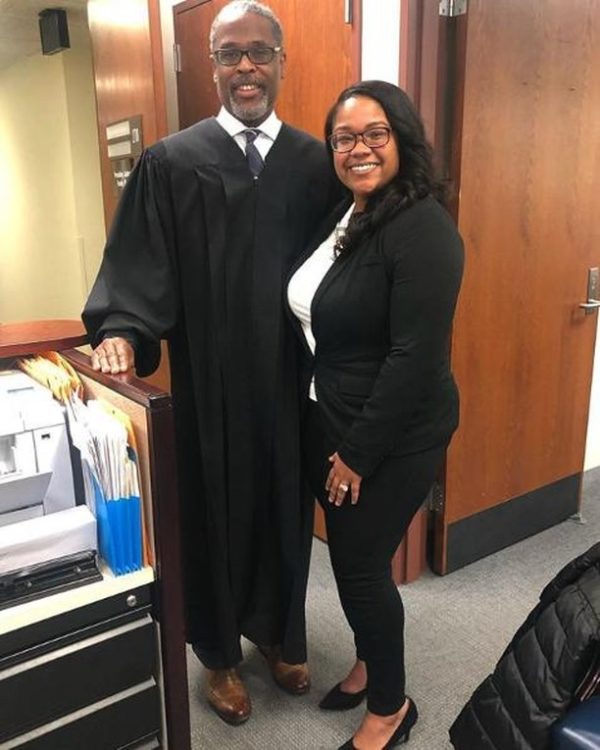
Superior Court Judge Charles Dortch reunited with soon-to-be law school graduate Carmen Day, who she said, “saw me as a girl who needed help, who needed a chance.” (Carmen Day/@rutgers.law Instagram)
Twelve years earlier before she became a wife and a mother, Day was a 17-year-old named Carmen Allen. In December 2006, she stood before Judge Dortch, himself an alum of Rutgers, as a juvenile defendant facing 18 months of probation. As she stood in Dorch’s chambers, he asked her if there was anything she’d like to say before her sentencing.
Then, Day explained her goal to attend law school, something NJ.com reported she was inspired to pursue thanks to her mom and watching Maxine Shaw, attorney-at-law, on “Living Single.”
“Maybe I’ll be a lawyer in your courtroom one day,” Day, who won’t detail the poor decision that led her to the hearing, remembered saying.
The remark made Dortch light up with pride. He complimented her for her poised response and lowered her probation to just six months. It ended in time for her to graduate from high school in June 2007.
So when Day reunited with the judge last month and spoke to him privately at his request, the soon-to-be J.D.-degree holder became emotional.
“He didn’t see me as a docket number, or some poor girl from Camden,” Day told NJ.com. “He saw me as a girl who needed help, who needed a chance.”
“She really stuck out in my mind. I saw a lot of perseverance in her face,” Dortch said after telling her in his chambers, “You made up your mind that you were going to control your environment and not let your environment control you.”
As inspiring as Day’s story — which was shared 5,000 times on Facebook — is, her road to obtaining a law degree wasn’t a smooth one. She dropped out of Camden County College twice and her education later took a back seat to the responsibilities of being an adult. By 2012, however, she enrolled at Burlington County Community College, where she earned her associate degree a year later.
Afterward, she enrolled in Rutgers University-Camden, where she double majored in political science and criminal justice and graduated in 2015. When she took the LSAT she didn’t score well but was able to take a conditional acceptance into law school by completing a program that allowed her to attend Widener University Delaware Law School in Wilmington, Delaware. After making the two-hour-a-day trek to and from the campus, she got into Rutgers Law.
“This is my testimony. I hope by sharing that I can encourage someone to keep living, keep fighting, and keep dreaming,” Day concluded on the Instagram post. “You are not what happened to you, you are what you choose to become.”


