NEW YORK (AP) — Anthony Davis’ agent let everyone know he wants out of New Orleans, and now it will cost his client $50,000.
The NBA fined the Pelicans star because of his agent’s comments that Davis won’t sign an extension and wants to be traded.
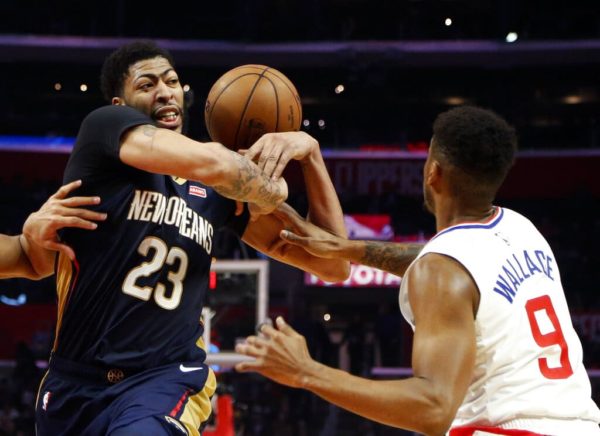
New Orleans Pelicans’ Anthony Davis, left, gets fouled by Los Angeles Clippers’ Tyrone Wallace during the second half of an NBA basketball game, Monday, Jan. 14, 2019, in Los Angeles. The Pelicans won 121-117. (AP Photo/Ringo H.W. Chiu)
The league office said in a written statement released Tuesday evening that Davis violated a collectively-bargained rule prohibiting players or their representatives from making public trade demands.
The NBA said the fine is for statements that were made by Davis’ agent, Rich Paul, on Monday in an intentional effort to undermine the contractual relationship between Davis and the Pelicans.
Davis is under contract with New Orleans through the end of the 2019-20 season.
He was drafted by the Pelicans with the first overall pick in 2012 after winning an NCAA national championship with Kentucky and has been named an All-Star the previous five seasons.
However, the Pelicans have made the playoffs in only two of his six full NBA seasons and won only won playoff series, sweeping Portland in the first round last season before falling in five games to champion Golden State in the second round.
Davis has averaged 29.3 points and 13.3 rebounds per game this season, but has missed the past four games with a sprained left index finger while the Pelicans have fallen to 22-28 heading into Tuesday night’s game at Houston.
Had Davis been committed to remaining in New Orleans, he would be eligible this summer for a five-year, roughly $240 million extension with the Pelicans that would have kicked in beginning with the 2020-21 season.
In previous years, Davis had professed his affection for New Orleans. But Davis has also said that his NBA salary is secondary to winning — a clear sign to Pelicans management that they could not take re-signing him for granted if they failed to take concrete and successful steps to surround him with a cast of players who would make New Orleans a contender.
When healthy, the Pelicans have looked formidable in short spurts, but injuries have exposed their lack of depth and cohesion as they’ve slipped near the bottom of the Western Conference through the first half of this season.
The Pelicans have acknowledged Davis’ preference to be traded and appear inclined to honor it rather than lose him for nothing. But a statement from the franchise made it clear that the Pelicans’ brass are prepared to be patient while awaiting a deal done on their terms and timeline.
The implication is that a trade may not come before the Feb. 7 deadline to make a deal this season, and more likely could come after the season, when 2019 draft slots are known and when the Boston Celtics are eligible to enter the fray.
Boston, which has a stockpile of draft picks and promising young players as trade bait, is not eligible to trade for Davis under NBA rules until July 1, unless the Celtics also trade away Kyrie Irving. Irving is a factor because of what’s known as the Rose Rule, which says NBA teams cannot trade for more than one player who has signed an extension. Irving currently is playing under an extension signed with Cleveland that has an option year after this season, meaning it could be renegotiated in a way that also allows Boston to bid for Davis.