Richard Overton, the nation’s oldest living World War II veteran and possibly the oldest man in the United States, died Thursday at a rehab facility in Austin, Texas. He was 112 years old.
Relatives said Overton was admitted to the hospital with pneumonia last week, then went to a rehab facility on Monday.
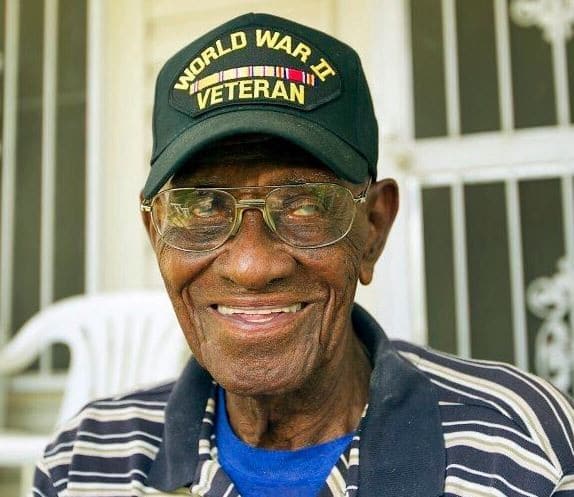
Richard Overton retired from the Army in 1945 and returned to Texas, where he worked as a furniture store salesman. (Image courtesy of KVUE)
“We’re truly gonna miss him,” his cousin Volma Overton Jr. told local station KXAN. “He was the joy of our days.”
Overton was born in Bastrop County on May 11, 1906 and served three years in the Army during World War II. His military service took him overseas to the South Pacific, where he served in Hawaii; Okinawa, Japan; Iwo Jima, Japan; and Guam from 1942 until 1945.
According to military records, Overton buried fellow soldiers, drove a Jeep for a lieutenant, and worked as base security during his time in the service. He told CNN in 2013 he didn’t like reminiscing about the war, however, saying, he “forgot all that stuff.”
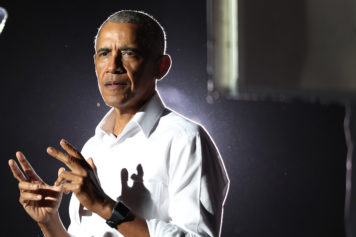
That same year, Overton traveled to Washington, D.C., on an Honor Flight with nearly three dozen other World War II veterans to visit the National World War II Memorial. He was honored six months later by former President Barack Obama at a Veteran’s Day ceremony at Arlington National Cemetery, where the crowd greeted the then-107-year-old with two standing ovations.
“His service on the battlefield was not always matched by the respect that he deserved at home,” Obama said during the 2013 ceremony. “But this veteran held his head high.”
Overton retired from the Army in October 1945 with the rank of corporal. He would return to Texas, where he worked as a furniture store salesman and for the Texas Comptroller’s Office (formerly the Texas Treasury Department). He stayed in the same east Austin home he’d built for himself after the war.
“Today, Richard still lives in the house he built all those years ago, rakes his own lawn and every Sunday, he hops in his 1971 Ford truck and drives one of the nice ladies in his neighborhood to church,” Obama continued. “So, this is the life of one American veteran living proud and strong in the land he helped keep free.”
The distinction of being America’s oldest veteran brought more than a few visitors to Overton’s front porch, FOX 7 Austin reported. One of them was former Gov. Rick Perry, who told the World War II vet, “I just wanted to come by and visit with you.”
Overton credited God for his long, healthy life and refused to let his age stop him from enjoying his vices: whiskey, women and smoking 12 cigars a day.
“I drink whiskey in my coffee. Sometimes I drink it straight,” he told CNN in 2013. “I smoke my cigars, blow the smoke out; I don’t swallow it.”
Two years later, Overton would spend a week at St. David’s Medical Center in central Austin battling pneumonia. He recovered, but would require around–the–clock care due to his old age. His family didn’t want him to go into a nursing home, and VA benefits would not cover in-home care. So, they launched a GoFundMe campaign that raised over $450,000, allowing Overton to stay in his home.
When he turned 111, FOX 7 reported that the Austin City Council voted to rename the street he’d lived on for 70 years as Richard Overton Avenue.
So what was Overton’s secret to longevity?
“Stay busy and talk to the Lord and live with the Lord,” he said. “Don’t live with the people. Live with the Lord. Let Him take care of you.”
Watch more in the video below.