WASHINGTON (AP) — Supporters of a criminal justice bill say they have met the threshold set by Senate Majority Leader Mitch McConnell for getting a vote.
Senate Judiciary Chairman Chuck Grassley, R-Iowa., said he now has support for the legislation from more than half of the Republicans in the chamber. Democratic leaders said support on their side is “overwhelming.” If true, their projections mean at least two-thirds of the Senate would vote for the bill.
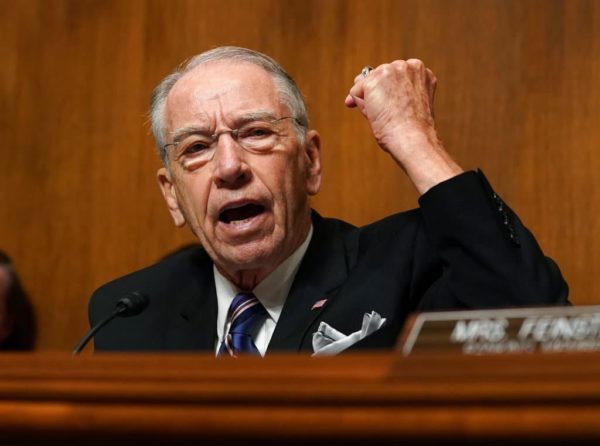
FILE – In this Sept. 27, 2018, file photo, Senate Judiciary Committee Chairman Chuck Grassley, R-Iowa, speaks as Christine Blasey Ford testifies before the Senate Judiciary Committee on Capitol Hill in Washington. . (AP Photo/Andrew Harnik, Pool, File)
McConnell “said, ‘show me the numbers. If it gets to be 65 or 70, I’ll bring it up,'” Grassley said during a forum sponsored by The Washington Post. “We’re there.”
Yet it remains unclear whether the legislation will receive a vote on the floor, with only a few weeks to go before a new Congress is sworn in.
McConnell has made no public commitments on the bill other than to say he would count the votes and weigh it against other priorities that the Senate must deal with, including a spending bill to avoid a partial government shutdown, a farm bill and judicial nominations.
The criminal justice bill would reduce mandatory sentences for certain drug crimes and give judges more discretion to make the punishment fit the crime. The White House supports the bill, but there are concerns from some senators that the president hasn’t been more active in rallying support.
“I don’t know why any Republican leader or any Republican member of the Senate wouldn’t be pleased to be able to deliver something bipartisan that the president supports,” Grassley said.
Grassley said he worries that, with Democrats taking over the House next year, the bill will be changed in a way that could make it harder for GOP senators to go along.
“We have a once-in-a-generation opportunity to accomplish something on criminal justice reform,” Grassley said.
“Don’t miss the opportunity, and we have it right now,” said Sen. Dick Durbin, D-Ill., who is working with Grassley on the bill.
Grassley’s calculations would indicate a couple dozen Republicans are undecided or are opponents of the legislation. Sen. John Cornyn of Texas, the second-ranking Republican in the Senate, disagreed with the depiction that the majority of 51 Republicans are a yes vote, telling reporters outside the Senate chamber, “I believe there’s a majority of the Republican conference that’s either undecided or a no.”
McConnell is reluctant to move forward with bills that are opposed by a signification portion of his caucus.
Sen. Tom Cotton, R-Ark., has led the opposition. He has been warning that the legislation endangers public safety.
Under the bill, the Bureau of Prisons can assign prisoners to serve the final portion of their sentences in halfway houses or home confinement. The bill says the bureau would provide that option only to prisoners who present a “minimal” or “low” risk of recidivism.
But Cotton is arguing that wardens could be pressured to categorize medium or even high-risk inmates as being at a low risk of recidivism.
“There’s no telling what a Democratic administration in the future would do to put pressure on wardens and give them incentives for their career advancement to let out high-risk prisoners,” Cotton said on the Hugh Hewitt Show.
Any legislation passed by the Senate would then have to be considered by the House.
Roughly 90 percent of prison inmates are held in state facilities and would not be affected by the legislation.