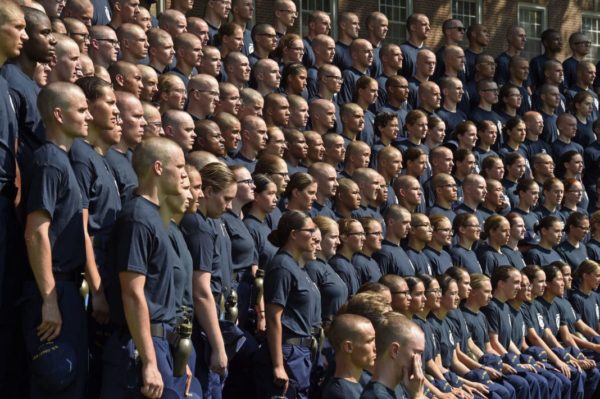
Members of the U.S. Coast Guard Academy Class of 2022 pose for their class photo on day one of Swab Summer at the academy in New London, Conn. (Sean D. Elliot/The Day via AP, File)
HARTFORD, Conn. (AP) — The Department of Homeland Security’s inspector general is investigating allegations of racial discrimination at the U.S. Coast Guard Academy and inadequate follow-up by the school’s leadership, the agency said Thursday.
The investigation will bring a new layer of scrutiny to the service academy that is already under pressure from Congress to address concerns about racial insensitivity, disparities in discipline and the administration’s handling of complaints.
The probe began within the last few months and could take up to a year, Arlen Morales, a spokeswoman for the Office of Inspector General, told The Associated Press. It will look into how the academy responds to allegations of race or ethnicity-based discrimination. Ultimately, the academy will be required to provide a corrective action plan, with the inspector general’s office updating Congress on any shortcomings.
U.S. Rep. Joe Courtney said the academy has made strides with mentoring programs and other initiatives to recruit and retain minorities but it is also clear work remains to be done.
“It’s an issue that’s got to once and for all get fixed,” said Courtney, a Democrat whose district in eastern Connecticut includes the academy’s New London campus. “What I think is good about the IG’s office is they give perspective in terms of solutions. That would be welcome.”
A spokesman for the academy said it was preparing a statement.
One of the nation’s smallest service academies, the Coast Guard Academy is overseen by Homeland Security, unlike others such as the U.S. Military Academy and the Naval Academy that are run by the Defense Department. It enrolls over 1,000 cadets, who attend the school tuition-free and graduate as officers with a bachelor of science degree and a requirement to spend five years in the service.
Like many other predominantly white institutions, it has struggled with diversity. This spring, it graduated its most diverse class ever, including 18 African-Americans in a class of 209 (8.6 percent), though last year it had only four black graduates in a class of 195 (2 percent).
In recent years, black cadets, in particular, have been raising concerns about the racial climate, including a perception that minorities are punished swiftly for slight infractions while others face little consequence for harassment. In one incident, when a white cadet played the song “If the South Woulda Won” in a black cadet’s room, the local NAACP said some were frustrated the white cadet was let off with an order to undergo sensitivity training.
In October, U.S. Rep. Bennie Thompson, a Mississippi Democrat and ranking member of the House Committee on Homeland Security, proposed legislation aimed at fostering a more inclusive environment at the academy. It calls for boosting geographic and racial diversity of cadets in part by requiring the academy to select up to half of each incoming class from a pool of candidates nominated by members of Congress.
In June, Thompson, Courtney and U.S. Rep. Elijah Cummings of Maryland asked the Coast Guard commandant for detailed information on harassment allegations and climate issues at the academy, requesting documents such as investigative reports within a month. Connecticut’s two U.S. senators sent a similar letter. Courtney said the academy has provided hundreds of pages but has been asked to remove redactions.
The academy launched several initiatives to ensure all cadets feel welcome on campus. It invited a review by the University of Southern California’s Center for Urban Education, which issued a report detailing disparities affecting black cadets in areas, including frequency of disciplinary action and graduation rates. The school’s superintendent ordered a working group to look into factors behind the gaps.