Five schoolgirls from Nigeria took home first place at the Technovation World Pitch Summit in San Jose, California last week for their groundbreaking mobile app addressing Nigeria’s deadly counterfeit drug market.
Teens Promise Nnalue, Jessica Osita, Nwabuka Ossai, Adaeze Onuigbo and Vivian Okoye — better known as “Team Save-a-Soul” — were just five of 2,000 app developers selected to represent Africa in the global tech competition, according to Quartz Africa. The World Pitch Summit is the largest tech entrepreneurship program for girls aged 10 to 18 years old and challenges developers to identify a problem in their communities and solve it.
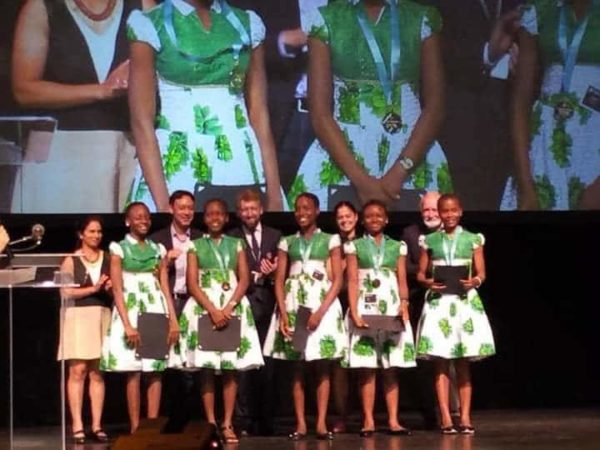
Promise Nnalue, Jessica Osita, Nwabuka Ossai, Adaeze Onuigbo and Vivian Okoye took home first place for their mobile app used to detect counterfeit drugs. (Image courtesy of Twitter)
The girls, who were mentored by STEM education advocate and 2017 Mandela Washington Fellow Uchenna Onwuaegbu-Ugwu, took home the top prize at the summit with their “FD Detector” (fake drug detector) mobile app. Experts say the app has the potential to save lives, as the National Agency for Food and Drug Administration and Control (NAFDAC) has long struggled to quell fake pharmaceuticals coming into the country.
Speaking to Nigeria’s Daily Trust, the girls said they were motivated to launch the app after seeing the rising number of deaths in Nigeria due to imitation drugs. African nations are the dumping ground for roughly 40 percent of the world’s fake drugs and several malaria deaths in Nigeria have been attributed to the use of counterfeit drugs, Quartz reported.
To address the issue, the girls will team up with NAFDAC to create a database of certified pharmaceutical drugs on which drug companies can upload their products once approved by the agency. Anyone with a smartphone, health professionals included, can then scan the barcode of a drug and the app will determine if it’s real or fake and display its expiration date.
Users can also use the app to report fake drugs to NAFDAC directly, according to the news site.
Nigeria’s vice president, Yemi Osinbajo, celebrated the girls’ victory in a Twitter post earlier this month.
“Congratulations! We are very proud of you,” he wrote, followed by a photo of the teens receiving their awards on stage at the competition.
This year’s Technovation winners will share a prize of more than $50,000 for seed funding and scholarships for further research.