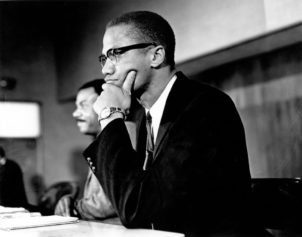
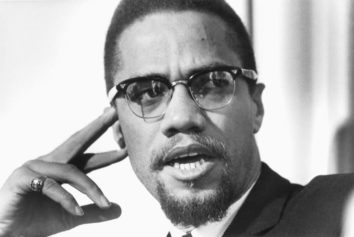
Black Nationalist leader Malcolm X attends a rally at Lennox Avenue and 115th Street in the Harlem neighborhood of New York. (AP Photo/Robert Haggins, File)
NEW YORK (AP) — For decades, a burning question loomed over a towering 20th-century book: “The Autobiography of Malcolm X”: What happened to the reputedly missing chapters that may have contained some of the most explosive thoughts of the African-American activist assassinated in 1965?
The answer came on Thursday when an unpublished manuscript of a chapter titled “The Negro” was sold by Guernsey’s auction house in Manhattan — for $7,000.
“We are like the Western deserts; tumbleweed, rolling and tumbling whichever way the white wind blows,” he writes. “And the white man is like the cactus, deeply rooted, with spines to keep us off.”
The buyer was The New York Public Library’s Schomburg Center for Research in Black Culture, based in Harlem.
Schomburg Director Kevin Young confirmed to The Associated Press that this was, in fact, an unpublished missing section of Malcolm X’s autobiography, whose 241-page draft the Schomburg also acquired Thursday for an undisclosed sum.
The manuscript of the autobiography was for years owned by Gregory Reed, a lawyer for Rosa Parks who purchased the collection from author Alex Haley’s estate.
The draft of the entire book is of immense value, beyond the historic, for the handwritten revisions and comments by Malcolm X and Haley, Young said in a telephone interview after the auction.
Their dialogue, in writing, reflects the human rights activism of the Muslim minister who indicted white America for what he saw as criminal behavior against blacks; opponents including the U.S. government accused him of inciting racism and violence. He was assassinated in Harlem in 1965 by three members of the Nation of Islam, a radical religious movement, shortly after he had broken away from the group.
The scribbled notes in the manuscript — not available until now — “are a very direct narrative that he’s crafting,” says Young, citing the image of racist cross-burning that Malcolm X’s mother described to him as a child. “And that’s what brings him into the world.”
One mystery was solved in public on Thursday, but another was born: loose fragments of Malcolm’s writing-in-the-works. Were these parts of possible other missing chapters?
“I examined them, and I don’t know what those are, it’s too early to tell; they look like they were probably stapled at one time, or cut and pasted; some are half of a page or just slips of paper,” Young said. “The best way to describe them is that they’re literal fragments and literary fragments.”
It may take years before the story of the fragments is pieced together.
“You see in these pages the history of black people in America,” concluded Young. “And we’re bringing the sons and daughters of Harlem home.”