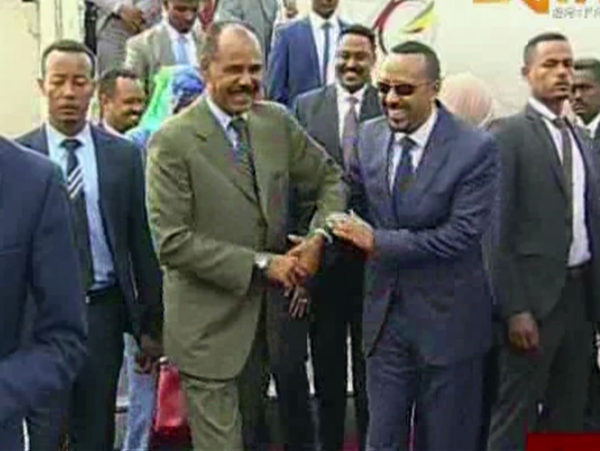
Ethiopia’s Prime Minister Abiy Ahmed, center right, is welcomed by Eritrea’s President Isaias Afwerki as he disembarks the plane, in Asmara, Eritrea. (ERITV via AP, File)
ADDIS ABABA, Ethiopia (AP) — Eritrea’s President Isaias Afwerki is visiting Ethiopia on Saturday, the latest step in an unprecedented diplomatic thaw between the former archrivals that is ending one of Africa’s longest-running conflicts.
Eritrea’s information minister, Yemane Gebremeskel, confirmed the visit on Twitter, saying it will “add momentum to the joint march for peace and cooperation.” The 72-year-old Isaias last visited Ethiopia in 1996.
The visit by the leader of one of the world’s most reclusive countries comes after Ethiopia’s new Prime Minister Abiy Ahmed made a historic trip to Eritrea last weekend for hugs, laughter and talks with Isaias, setting off the restoration of diplomatic ties after two decades.
Some jubilant Ethiopians compared it to the fall of the Berlin Wall in 1989. Now phone lines are restored and scheduled Ethiopian Airlines flights to Eritrea begin next week.
Abiy’s chief of staff, Fitsum Arega, confirmed the Eritrean president’s three-day state visit, saying on Twitter: “We welcome him warmly!” The old Eritrean embassy was being spruced up to open during the visit.
The thaw began when the 42-year-old Abiy, who took office in April, announced Ethiopia would fully accept a peace deal that ended a two-year border war that killed tens of thousands and separated families.
The decision, which hands disputed border areas to Eritrea, was the boldest move yet in a wave of reforms in Ethiopia, Africa’s second most populous country, after years of anti-government protests.
The United States, the U.N. Security Council and others have praised the end of the countries’ state of war, with the council calling it a “historic and significant development with far-reaching positive consequences for the Horn of Africa and beyond.”
Ethiopian state media reported that the Eritrean leader is expected to visit an Ethiopian industrial park and that both leaders will attend a large concert on Sunday featuring local artists and an audience of about 25,000.
Tiny Eritrea, located on one of the world’s busiest shipping lanes and across the Red Sea from the Arabian Peninsula, has been ruled by Afwerki since gaining independence from Ethiopia in 1993 after years of rebel warfare. Eritrea has become a major source of migrants fleeing toward Europe, Israel and African nations in recent years as human rights groups criticize its harsh military conscription laws.
Observers now wonder whether the end of fighting with Ethiopia will lead Eritrea to open up and embrace new freedoms.