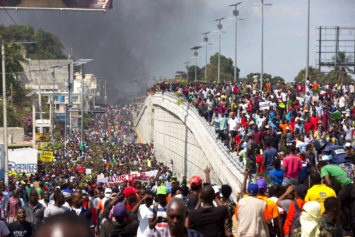
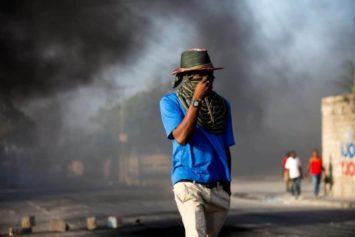
A police officer walks through the parking lot of the Delimart supermarket complex, where vehicles sit charred and looted merchandise lies scattered after two days of protests against a planned hike in fuel prices in Port-au-Prince, Haiti, Sunday, July 8, 2018. (AP Photo/Dieu Nalio Chery)
PORT-AU-PRINCE, Haiti (AP) — The Haitian government suspended a fuel price hike Saturday after widespread violence broke out across the capital and in the northern city of Cap-Haitien.
Prime Minister Jack Guy Lafontant had originally said the country needed to raise prices to balance the budget and gave no indication he would back down.
But his administration bowed to pressure after demonstrators took to the streets in protest.
A journalist from The Associated Press reported seeing several hundred people on Saturday attack a Best Western Premiere hotel in Petion-Ville, one of the capital’s wealthiest neighborhoods. Guests were forced to remain inside as rocks were hurled through windows around 10 a.m. local time.
Security manned the building, but rioters shattered the main entrance before moving to another hotel.
No injuries or deaths were reported during the day’s incidents, but at least three people were killed Friday as protesters used burning tires and barricades to block major streets. At one point they attempted to set a gas station on fire but were held off by police.
The demonstrations began after the Commerce Ministry and Economic Ministry issued a joint statement announcing an increase of 38 percent to 51 percent for gasoline, diesel and kerosene.
Government officials agreed to reduce subsidies for fuel in February as part of an assistance package with the International Monetary Fund. The agreement also included increased spending on social services and infrastructure and improved tax collection in an effort to modernize the economy of one of the poorest nations in the Western Hemisphere.