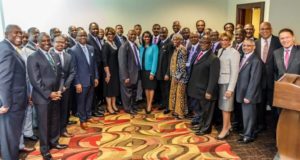
Leaders of the AME Church announced the partnership late last month. (Photo by Klarque Garrison/Trice Edney News Wire)
The African Methodist Episcopal church, the first independent Black denomination in the U.S., has teamed up with 19 Black-owned banks across the nation to form a partnership aimed at bettering financial vitality among Black Americans.
Bishop Reginald T. Jackson announced the new partnership at the 2018 Council of Bishops and General Board Meeting in Atlanta on June 26, pegging the initiative as an opportunity to “increase Black wealth,” business development and homeownership.
“This initiative will strengthen Black banks across the U.S. and increase their capacity to lend to small businesses, to secure mortgages, to provide personal lines of credit, and to offer other forms of credit to AME churches and our members,” said Jackson, president of the Council of AME Bishops. “This, of course, includes enabling members and their families to become homeowners.”
Jackson explained the partnership was inspired by an initiative formed in Washington, D.C. in 2015, called Black Wealth 2020, which he said “… is providing an economic blueprint for Black America.”
Through the initiative, faith leaders and bank presidents hope to increase deposits and loans with Black-owned banks; up the number of Black businesses from 2.6 million to 4 million; and grow Black homeownership to more than 50 percent nationwide, according to a press release.
Speaking to The Atlanta Voice, General Board Chair Bishop Vashti Murphy McKenzie said he believes the church-bank collaboration is especially important for African-American youth.
“We want to be able to teach fiscal responsibility before [students] get to high school,” she said. “[It’s important] to learn the value of saving, the value of investing.”
Michael Banks, former head of the National Bankers’ Association, said he sees the partnership as imperative in regards to growing Black homeownership.
“We are educating ourselves and not only teaching our people how to get a home but also how to stay there,” Banks told the newspaper. “We worry about gentrification, but we have more power than we realize. (It’s important) to (buy) a home, and hold on to a home, and then encourage all young people to do the same.”
With over 6,000 AME churches across the U.S., faith leaders say the partnership is a real opportunity to boost wealth among Black Americans if everyone takes part.
“We believe that if most of these churches participate, more than $6 million dollars in new business can be generated,” Jackson wrote. “This could also generate in three years more than $1 billion dollars in construction loans.
“The impetus for this partnership is not only what it does for Black banks, but also what it can do for Black Americans and churches.”