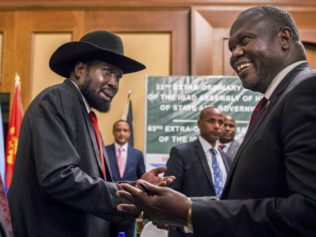
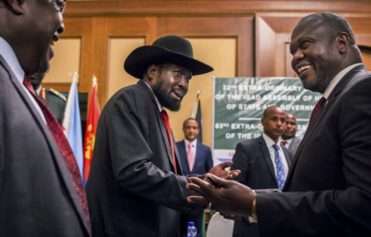
ADDIS ABABA, Ethiopia (AP) — South Sudan’s armed opposition on Thursday rejected any “imposition” of a peace deal and asked for more time after the first face-to-face meeting between President Salva Kiir and rival Riek Machar in almost two years.
An opposition statement called Wednesday night’s meeting “cordial” and said the two sides discussed the prospects for peace “in broad terms.” But it warned that the current model for the peace process is “unrealistic” and that “there is no shortcut to peace.”
Kiir and Machar met in neighboring Ethiopia, whose Prime Minister Abiy Ahmed invited them and presided over discussions.
Images showed the rivals being coaxed by Abiy into an awkward hug.
South Sudan’s five-year civil war has continued despite multiple attempts at peace deals. Tens of thousands of people have died and millions have fled to create Africa’s largest refugee crisis since the 1994 Rwandan genocide. Millions of others still in the country are near famine, while the warring sides have been blamed for obstructing or slowing the delivery of desperately needed aid.
Kiir and Machar shook hands again Thursday as regional heads of state and government discussed the civil war. The East African regional bloc, the Intergovernmental Authority on Development, has led several rounds of failed peace talks. It was not clear whether Kiir and Machar met privately Thursday.
“We cannot continue with business as usual,” Ethiopia’s prime minister told the gathering. “If … the different parties are unwilling and unable to halt the suffering of their people, we need to put them on notice that we are ready to act.”
Regional bloc IGAD has threatened to submit “punitive measures” against violators of December’s failed cease-fire, though sanctions would need approval by the bloc’s heads of state and government.
Opposition spokesman Mabior Garang, who issued Thursday’s statement, told The Associated Press that a peace deal at the moment was “not likely” and that it “wouldn’t be a genuine agreement.”
Machar fled South Sudan after new fighting erupted in the capital in July 2016, ending a brief attempt at peace in which he returned to his role as Kiir’s deputy. The latest attempt at a cease-fire was violated within hours.
Weary South Sudanese civilians watching the latest developments called for Kiir, Machar and their supporters to put the country’s fate first.
“The people of South Sudan want peace now and (they) need the leaders to sacrifice their personal ambitions for its sake,” the editor of a newspaper forced to shut down by the government, Wol Deng Atak, told the AP.
Both sides have been accused of widespread abuses such as gang rapes against civilians, including along ethnic lines. A number of South Sudan officials have been accused by human rights groups of profiting from the conflict and blocking the path to peace.
Early this month the U.N. Security Council adopted a United States-sponsored resolution that threatens an arms embargo on South Sudan and sanctions against six people, including the country’s defense chief, if fighting doesn’t stop and a political agreement reached. The resolution asks Secretary-General Antonio Guterres to report to the council on that by June 30.