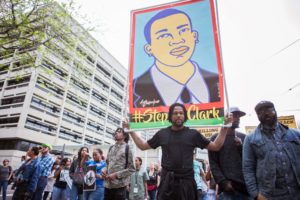
Hundreds gather at the Sacramento District Attorney’s office on April 4, 2018 demanding justice for police shooting victim Stephon Clark (Photo by Vanessa S. Nelson / Capital Public Radio)
A recent report published in a leading British medical journal has confirmed concerns long-held by racial justice activists: police killings of African-Americans has damaging effects on the mental well-being of Black communities.
The study, published in The Lancet this week, found that when U.S. officers shoot and kill unarmed Black people, it has a negative impact on the mental state of Black Americans in those states Researchers pored over mental health survey data and a database on police shootings to solidify their findings, which they described as “observable and real.”
“‘Having seen something so horrific and traumatic that happened to someone else, I’m reminded in a very painful and salient way that the deck might be stacked against me’ ” study author Atheendar S. Venkataramani told The New York Times of how Black people might view police killings. “It’s really about all the kinds of insidious ways that structural racism can make people sick.”
Researchers found that Black people reported more “not good” mental health days in the period after a police shooting of an unarmed Black person, adding that the killings accounted for up to 1.7 additional poor mental health days per year.
Meanwhile, police shootings of unarmed Black folks didn’t have a similar effect on the mental state of white Americans like it did on African-Americans. There were also no negative health effects connected to police killings of unarmed white Americans or armed Black Americans.
Venkataramani, a health policy professor at the University of Pennsylvania, and fellow researchers Jacob Bor of Boston University, Alexander C. Tsai of Massachusetts General Hospital and David R. Williams of Harvard University, described their study as an attempt at examining the measurable harms of state-sanctioned violence on the broader psychological and mental well-being of Black Americans, The New York Times reported.
Together, they analyzed survey responses from the Behavioral Risk Factor Surveillance System between 2013 to 2016 and juxtaposed them to questions about mental health from a database on nationwide police killings called Mapping Police Violence.
Some of the killings cited in the study included the police shooting of Oscar Grant III in 2015, the chokehold death of Staten Island man Eric Garner in 2014 and the shooting of Stephon Clark earlier this year, among others. Venkataramani said the report’s findings may actually understate the trauma caused by these killings and incidents like them.
“Maybe this is the tip of the iceberg,” he said.