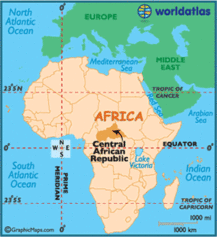
THE HAGUE, Netherlands (AP) — In a blow to prosecutors at the International Criminal Court, appeals judges overturned Friday the convictions of former Congolese Vice President Jean-Pierre Bemba for atrocities committed by his forces in Central African Republic.
The reversal delivered a serious setback to ICC prosecutors by scrapping all the convictions in the court’s first trial to focus largely on sexual violence and on command responsibility — the legal principle that a commanding officer can be held responsible for crimes committed by his or her troops or for failing to prevent or punish the crimes.
The ruling could have implications for possible future convictions of commanding officers in other conflicts.
“It was the right decision,” said Bemba’s lawyer Peter Haynes, “but it was a brave decision.” Haynes said he would work to get Bemba released as soon as possible.
Bemba was the most senior suspect convicted by the global court and his 18-year sentence was the highest handed down in the court’s history.
Bemba, wearing a suit and tie, showed little emotion as Presiding Judge Christine Van den Wyngaert reversed his convictions. Bemba’s supporters in the packed public gallery were not so reserved; they cheered, whistled and hugged one another for so long that Van den Wyngaert threatened to halt proceedings if order was not restored.
The appeals chamber, in a 3-2 majority ruling, said the trial chamber “erred in its evaluation of Mr. Bemba’s motivation and the measures that he could have taken in light of the limitations he faced in investigating and prosecuting crimes as a remote commander sending troops to a foreign country.”
The appeals chamber also said Bemba was wrongly convicted for crimes that were not even included in the charges against him.
The two judges who disagreed wrote a dissenting opinion in which they said the acquittals were based on “an incorrect standard of appellate review,” the court said in a statement.
Bemba was found guilty in 2016 as a military commander of two counts of crimes against humanity and three counts of war crimes for a campaign of murder, rape and pillaging by his troops, known as the Movement for the Liberation of Congo, in 2002 and 2003. He denied responsibility for the crimes. He was sentenced in 2016 to 18 years in prison.
Bemba has been in custody at the ICC for nearly a decade after authorities in Belgium arrested him there in 2008 and sent him to The Hague.
Van den Wyngaert said Bemba would not immediately be released because a separate panel of ICC judges is still considering what sentence he should be given in a conviction for interfering with witnesses in his trial. She urged that trial panel to quickly decide whether he should be set free.
Bemba, a former Congolese senator and vice president, was the commander of the Movement for the Liberation of Congo when he was asked in 2002 and 2003 to send troops by President Ange-Felix Patasse in neighboring Central African Republic.
At the time of his original conviction, judges said women, girls and men were targeted by Bemba’s forces, often with multiple soldiers raping women and girls in front of family members.
In one incident, a man’s wife was gang-raped and when he protested he, too, was raped at gunpoint.
Friday’s ruling does not mean those crimes did not take place, but that Bemba cannot be held criminally responsible for them.
Solomon Sacco, head of the international justice team at Amnesty International, said the acquittals “will be felt as a huge blow for the many victims of the ‘war against women’ waged in the Central African Republic through a horrifying campaign of rape and sexual violence.”
Prominent Congolese opposition leader Felix Tshisekedi, speaking at an Atlantic Council event last month in Washington, said Bemba’s Movement for the Liberation of Congo was part of a new political alliance against President Joseph Kabila. Frustration is rising in Congo against Kabila as presidential elections have been delayed since late 2016.