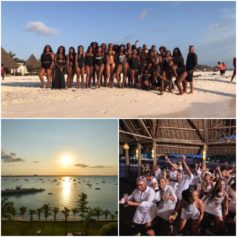
Black American tourists have been largely ignored by some of Africa’s most notable tourism boards, which mostly market to white U.S. travelers. (Image courtesy of Travel Noire)
The Black travel movement continues to gain steam here in the United States, as more and more African-Americans seek to discover their cultural heritage via trips to the Motherland. Many of Africa’s notable tourism boards are guilty of neglecting this new wave of travelers, however.
This issue lies in the fact that most of these companies have a homogeneous view of U.S. travelers — one that’s dominated by the white American majority, according to travel news site Skift. Though Black Americans account for just 13 percent of the U.S. population, data from Mandala Research revealed that Black travelers spend close to $48 billion every year on traveling and are among one of the fastest growing segments in the country.
The significant uptick in Black travel now has African tourism companies scrambling to find new and improved ways to market to the Black U.S. traveler.
“It’s more of a realization that you need to develop separate and distinct strategies in understanding that market,” Naledi Khabo, the executive director for the Africa Travel Association, told Skift.
Dinky Malikane, the global manager of South African Tourism, offered a similar strategy, saying, “We got to talk about the destination in platforms where we will reach the African Americans.”
“We got to look at partners who have a footprint in that segment,” Malikane added. “We are going to be very deliberate in who we can choose to be our partners, who must align with our thinking.”
As African tourism boards slowly perfect their strategies, some Black Americans refuse to wait and have taken it upon themselves to explore the African continent. Entrepreneur T. Michelle Curry created the Travel Africa Movement as a means of offering a curated experience for Black tourists hungry for adventure — something Africa’s tourism boards haven’t been able to offer.
Speaking to Skift, Curry said the goal is to make the average African-American consider traveling to Kenya’s sandy beaches as quickly as they’d consider jetting off to places like Italy or Dubai.
“Certain tourism boards, like South Africa and Ghana, are better than others. But generally, I don’t think that African tourism boards do a good job in reaching out to African-Americans through marketing efforts,” Curry said. ” … They seem to focus on Europe and Europeans, which is understandable due to the closer proximity, but they are missing out on a lot of opportunity.”
Africa’s whitewashed marketing campaigns remain an issue, but the continent’s tourism boards have expressed sincere interest in attracting more Black U.S. travelers.
“When they come, they feel [like it’s] home,” Rehab Samir Mohamed, international tourism coordinator for the Egyptian Tourism Authority told Skift. “We like to see them in our country because they are home.”