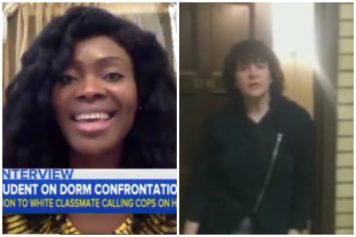
FULL INTERVIEW: NBA rookie Sterling Brown tells @RobinRoberts he felt "defenseless" when police surrounded him in a parking lot and tased him in exclusive interview. https://t.co/fsfUhegrRr pic.twitter.com/WeGCsCCQT8
— Good Morning America (@GMA) May 25, 2018
Sterling Brown, the NBA rookie who was tased and arrested at a Milwaukee drug store earlier this year has now broken his silence on the matter.
In January, the Milwaukee Bucks guard was caught on video, which was released this week, surrounded by local police after being questioned for double parking.
“You don’t see the issue here? You’re not parked across three lanes?” the officer asks Brown.
When six back up officers arrived on the scene, Brown tells “Good Morning America” he “felt like it was unnecessary.”
“Everybody thought I was combative, thought I was, you know, being aggressive,” Brown says of the officers’ claims, despite the video footage showing otherwise. “I get mad every time I watch it, you know, ’cause I was defenseless, pretty much,”
The situation escalated with Brown being accused of “being all badass” with an officer. Another cop commanded Brown to take his hands out of his pockets and when Brown says he has “stuff” in them, officers tackle him to the ground. The NBA player was tased, placed in handcuffs and arrested.
“I’m still on the ground for about ten minutes,” he explains. “Still wet, face to the ground, knee in my neck and I was [thinking], ‘OK, How do I get outta this? How do I get home? How do I see my family?”
“They wanted to control the situation, they wanted to show their force, their power,” he added of why things escalated the way they did.
Milwaukee Police Chief Alfonso Morales at a Wednesday press conference condemned the use of force against Brown, saying the officers “acted inappropriately” and were “recently disciplined.” However, he did not detail how the cops were punished.
For those who say Brown should not have parked illegally and complied with officers, he told GMA “it shouldn’t have led to what it led to.”
“I could have just got a ticket, went home, paid however much money,” he continues.
He says with the civil suit he’s filed, he hopes to hold other officers accountable, help change policies and assist locals with not getting into similar situations.
“That’s why I’m … doing what I’m doing legally,” he said. “I’m here speaking to you, you know, just to draw attention to it and try to, you know, be that voice and try to help as many people as I can in this situation.”
In response to Brown’s interview, several people still poked holes in the situation, blaming him for the outcome.
“Next time listen to law enforcement,” a Twitter user said. “He thinks because he is a basketball player he can be a smart ass, and he thinks he knows better. Dummy. Of course, he takes the race card and runs with it. [These] Democrats are brainless.”
“What a disgusting interview,” someone else tweeted. “HE broke the law on parking in a handicapped parking space and COPS do come in pairs. Stop making something over nothing OMG bigotry alive and well with [Robin Roberts]. What about white women???”
“I get the police were wrong in the way they acted, but what about the fact this guy parked illegally in TWO handicap spots??” another said. “Did he get a fine for that? Bet not! Lesson is if ur a pro athlete you can do wrong and get away with it.”
Still, one person slammed the way folks pinned Brown for the episode.
“It’s disgusting after all that’s happened over the years [for] people to immediately justify cops use of excessive force,” one user said. “He admitted to parking incorrectly. Who was it affecting at 2 a.m.? [Why] not give him a ticket? You racists bigots who need everything explained to you can go to hell.”