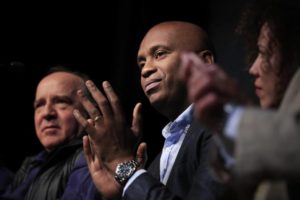
Havana-born artist Roberto Diago, center, and Cuban designer Celia Ledón, right, join other Cuban artists during a news conference at the Kennedy Center in Washington, Tuesday, May 8, 2018. . (AP Photo/Manuel Balce Ceneta)
WASHINGTON (AP) — Renewed tensions between the U.S. and Cuba aren’t stopping the John F. Kennedy Center for the Performing Arts from shining a spotlight on the island’s rich cultural heritage during what’s being billed as the largest Cuban arts festival ever held in the United States.
“Artes de Cuba: From the Island to the World,” which began this past week and runs through May 20, showcases the work of more than 400 Cuban and Cuban-American artists across more than 50 events. The program includes the salsa band Los Van Van and other musicians, visual artists, movies, theater companies and ballerina Alicia Alonso and the Ballet Nacional de Cuba.
“Cuba is a cultural powerhouse, and to present such a diverse slate of Cuban and Cuban-American artists all in a two-week span is unprecedented,” said Deborah F. Rutter, president of the Kennedy Center.
The festival is not without controversy.
It has come under fire from Cuban-American lawmakers, including GOP Reps. Carlos Curbelo, Mario Diaz-Balart and Ileana Ros-Lehtinen of Florida, as well as Rep. Albio Sires, D-N.J. They wrote to Secretary of State Mike Pompeo in April urging him to consider the advisability of allowing “so many pro-Castro regime Cuban nationals” to enter the United States.
Last year, the United States withdrew more than half of its diplomats from Cuba and halted visa processing, citing mysterious “health attacks” in Havana that have harmed at least 24 Americans. Full diplomatic ties between the U.S. and the communist nation had been restored in 2015, under the Obama administration.
Curator Alicia Adams, vice president of International Programming and Dance at the Kennedy Center, pushed back at the notion that the festival has ideological overtones.
“It is important for people in this country to be exposed to, in the aggregate, the extraordinary talent that exists in Cuba,” she told The Associated Press. “The Kennedy Center has a golden rule, and that is that we maintain the ultimate curatorial authority. Neither the Cuban government nor the American government dictated to us who the artists should be.”
Cuban fashion designer Celia Ledon, 32, who is showing 10 pieces in the festival, said the festival is not political, but rather “an eclectic representation of what the Cuban culture is about.”
Artist Roberto Diago, who lives in Havana, also is participating in the festival with two installations made of recycled materials. He said his installations convey how “people overcome (obstacles) and go beyond misery to build a reality as worthy as possible.”
“Unfortunately, the political situation is tense,” he said. “Politics always go their own way … but culture and its international language create brotherhood. I think that is positive.”


