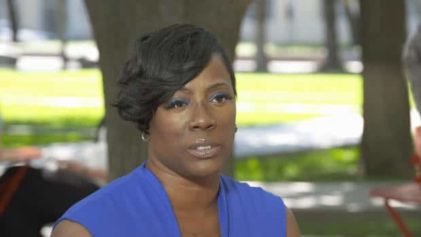
Critics were quick to point out the racial double standards of two cases involving voter fraud. (Images courtesy of Local News Only/Facebook)
A Texas county judge has been sentenced to five years probation after admitting to rigging his own election. However, critics have been quick to question how he managed to walk away with a slap on the wrist – compared to the five-year prison sentence a Black woman in the same county received for voting “illegally.”
Tarrant County Justice of the Peace Russ Casey resigned from his job last month after he pleaded guilty to submitting fake signatures to secure his spot on the primary ballot, The Fort Worth Star-Telegram reported. Casey was originally sentenced to two years in prison, but his sentence was ultimately probated to five years.
” … I apologize to the citizens of Tarrant County, the Tarrant County Republican Party, my family and friends for the way I’ve ended my judicial career,” Casey wrote in a statement. “Today’s proceedings have begun my transition from public to private life.”
Things turned out much differently for Texas woman Crystal Mason, who was sentenced by a judge to five years in prison after she “illegally” cast a ballot in the 2016 election. Mason, who was on supervised release from a three-year prison stint for tax fraud, claims she was totally unaware she was unable to vote while still on probation.
“They tell you certain things like you can’t be around a felon, you can’t have a gun,” Mason told the Fort Worth Star-Telegram. “No one actually said, ‘Hey, you can’t vote this year.’ ”
Emily Farris, a political science professor at Texas Christian University, was the first to point out the racial hypocrisy of the two cases.
https://twitter.com/emayfarris/status/988459753943613442?ref_src=twsrc%5Etfw&ref_url=http%3A%2F%2Fwww.star-telegram.com%2Fnews%2Fpolitics-government%2Felection%2Farticle209641279.html&tfw_site=startelegram
“We know that there is a great amount of racial disparity in sentencing, but this is a pretty stark comparison to illustrate that,” Farris, told the newspaper. “We know that voter fraud is fairly uncommon and pretty rare.”
“I find it a little disheartening when there is a real case of fraud … abusing the public’s trust, that this incident has a different outcome than the other ones,” she added.