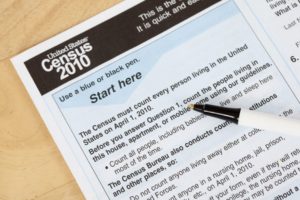
Census respondents can identify as “Nigerian” or “Jamaican” on the new questionnaire. (Image courtesy of Getty Images)
New changes are coming to the 2020 census, including an area asking Black Americans to designate their nation of origin.
Under the check box for “Black or African-American,” the U.S. Census Bureau is adding a space on its questionnaire for participants to write in their non-Hispanic origins, according to a January memo from the head of the 2020 census obtained by NPR. “African American,” “Jamaican” and “Nigerian” are just some of the options the bureau is testing for the 2020 census.
The “white” category will also include a write-in area for national origins, NPR reported, where respondents can identify as English, Italian, Egyptian or German, among other options.
Though the bureau has not given a specific reason for the changes, researchers at the agency say they’ve been trying to respond to requests “for more detailed disaggregated data for our diverse American experiences as German, Mexican, Korean, Jamaican and myriad other identities.”
For many Black people in the U.S., the new write-in area will allow them to be more specific about their national identity. The inquiry will prove easy for Black immigrants who can trace their origins back to a specific country, but things could become thorny for U.S. born Blacks who have a tougher time tracing their origins.
“I’m African. I identify as Black — but I don’t see myself as an African-American,” Niat Amare, who was born in Ethiopia and now lives in New York, told NPR. “We can’t just be black as African-Americans. We are black from Africa. We are black from the Caribbean. We’re Black from everywhere.”
Some Black people have voiced concern over the questionnaire’s latest addition, however, citing growing distrust among Black Americans in handing over personal information to the feds. Mulusew Bekele of the African Services Commitee said that distrust could prove to be a “major hurdle” for the bureau.
“Are people willing to answer that question given the current anti-immigrant sentiment? That I can’t tell,” said Bekele, who’s Ethiopian-American.
Christina Greer, a political science professor at Fordham University, shared similar concerns, telling NPR that fewer Black folks participating in the census could result in an undercount that has long-lasting impact. For one, it could affect the redistribution of seats in the House of Representatives as well as the drawing of legislative districts.
“This keeps me up at night because it’s not just about filling out the census,” Greer said.
Still, there are those who plan to embrace the new changes. Amanda Lugg, the director of advocacy for people living with HIV, said more detailed census data about Black folks’ origins would be beneficial for the public health work at her organization.
“This is a great step forward in terms of being able to get more specific information on who’s actually living here,” said Lugg, who’s a Black Brit.