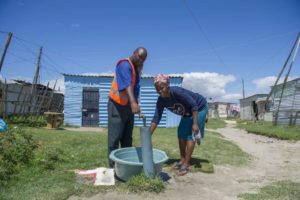
People collect water from a communal tap at an informal settlement near Cape Town, South Africa, Tuesday, Jan. 23, 2018, as a harsh drought may force South Africa’s showcase city of Cape Town to turn off most of its taps. (AP Photo)
JOHANNESBURG (AP) — South Africa’s police and military will help secure water collection sites in drought-stricken Cape Town if authorities must turn off most taps on what they call “Day Zero,” a date currently projected to fall in the first half of April, the city said Sunday.
Hospitals, key economic and industrial areas and densely populated areas with a higher risk of disease would be exempt from a water cut-off, said municipal authorities, who plan to open a disaster operations center on Monday to prepare for a possible closure of taps in a city known internationally for its natural beauty and tourist attractions.
South Africa’s second-biggest city ramped up contingency plans as the water crisis hurt tourism and politicians bickered over alleged failures to offset a looming disaster blamed on explosive population growth over the last two decades and several years of drought that scientists say was possibly exacerbated by man-made global warming.
Cape Town’s roughly 4 million residents can avoid “Day Zero,” slated for April 12, by each using no more than 50 liters (13.2 gallons) daily until adequate rainfall fills up depleted reservoirs and additional supply from aquifers, desalination and recycling schemes is activated, according to the city.
Security forces would guard 200 water collection points where residents can pick up 25 liters (6.6 gallons) daily if the tap cut-off occurs, authorities said. Providers of bottled water are being encouraged to increase supply so people have the option of buying water, and water tankers would deliver to homes for the elderly and other care facilities.
“This crisis will demand a whole of society approach, where we all pull together to get through this,” the city said in a statement that acknowledged “panic” among residents fretting over the possible difficulties ahead.
This weekend, Cape Town’s water and sanitation department said it was investigating reports that some retailers might be illegally selling municipal tap water after people were seen lining up with empty bottles at two malls. Some residents are supplementing water supply by collecting from natural springs in the city.
Cape Town is run by the opposition Democratic Alliance party, which says the national government of the ruling African National Congress party has failed to deliver water to all municipalities as required by law. On Sunday, the ANC’s provincial branch said the “Day Zero” warning was an opposition gimmick to drum up a sense of “gloom and doom” and suggested its own solutions, including reductions in production by brewers and soft drink companies.
“We need water, not sugary and alcoholic drinks,” the party said.
Meanwhile, tourism is taking a hit. Agencies have received cancellations from domestic and international travelers, said Cape Town Tourism CEO Enver Duminy, according to the African News Agency. He did not provide data on cancellations.
One visitor to Cape Town this weekend was Olympic great Usain Bolt, who attended a horse racing event. He was asked about the city’s crisis at a news conference.
“Don’t waste water,” the Jamaican said. In the Caribbean, he said, “we have this issue sometimes.”