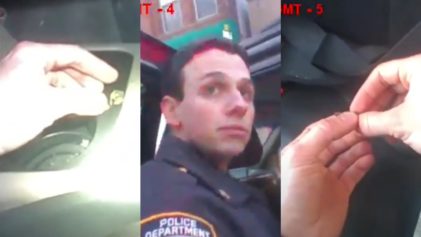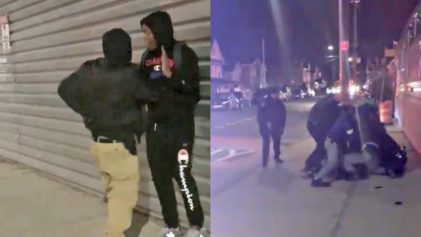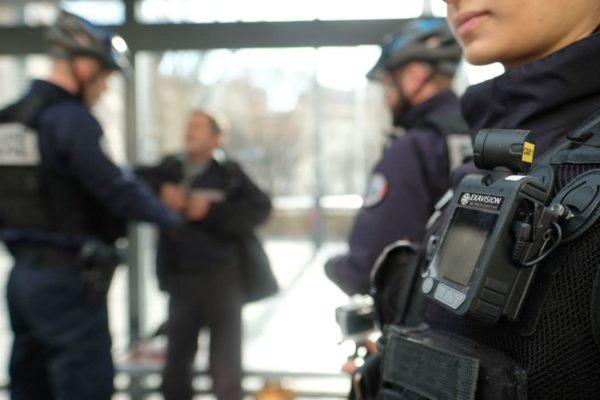
A New York City official argued against the police union’s claims, saying that body cam footage is not subject to the laws laid out in the city’s Civil Rights Law. (Photo by BORIS HORVAT/AFP/Getty Images)
New York City’s largest police union has filed suit against Mayor Bill De Blasio in an effort to stop the release of any and all body camera footage obtained by the NYPD.
The 30-page petition, filed by the Patrolmen’s Benevolent Association on Jan. 9, argues that the release of such police video violates the civil rights of NYPD officers, Newsweek reported. It also alleges that New York State Civil Rights statutes prohibit the release of records used to assess performance “towards continued employment [or] promotion” – unless otherwise granted access by a court order.
“These selective releases are clearly prohibited by statute [and] a long-standing court precedent, and reflect a reckless disregard for very serious safety, privacy, due process, and other interests,” attorney Michael Bowe wrote in a memorandum filed alongside the lawsuit.
Moreover, the PBA charged that stopping the release of footage captured by police body cameras would prevent respondents from “…selectively releasing footage to serve their own political or other objectives.” Their lawsuit also warned against making such footage public, arguing that it has the potential to create prejudice “toward those accused of wrongdoing or to the investigation or prosecution of such potential wrongdoing.”
In a statement, PBA President Patrick Lynch slammed De Blasio and the NYPD, accusing both of showing “reckless disregard” for officers’ concerns and claiming that both are guilty of “selectively releasing portions of videos to suit their own interests.”
“The basis of this suit is simple: we’re suing to prevent the Mayor and the NYPD from arbitrarily and illegally releasing body camera footage,” Lynch said in a statement.
“Nobody with a stake in these issues should be comfortable with this politicized, secret and unchecked process,” he continued. “Not the district attorneys, not good government advocates, not the public, and certainly not police officers and their families whose personal safety is being placed at risk.”
Speaking to Newsweek, a city official said police body camera footage is NOT subject to the civil rights rules laid out in the PBA lawsuit. Rather Civil Rights Law Section 50-a was enacted with the goal of preventing the release of disciplinary records that could be exploited and to block the release of highly sensitive personnel files.
In the event of a “critical incident” involving body cam footage, however, authorities may take the video and create a new version with necessary redactions, the official explained.
The police union doesn’t acknowledge this argument in its complaint, according to the newspaper.
New York City launched its police body cam program in April 2015 with the goal of having all its patrol officers equipped with the tiny devices by the end of 2019.