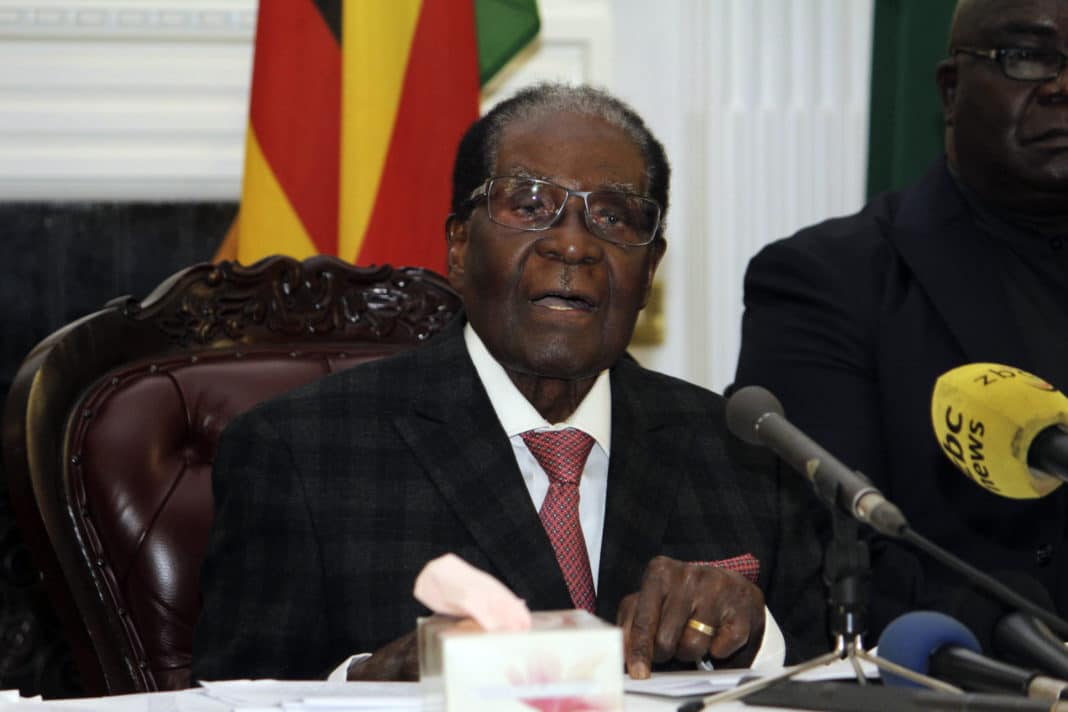
Zimbabwean President Robert Mugabe delivers his speech during a live broadcast at State House in Harare, Sunday, Nov, 19, 2017. Zimbabwe’s President Robert Mugabe has baffled the country by ending his address on national television without announcing his resignation. (AP Photo)
HARARE, Zimbabwe (AP) — Zimbabwe’s Robert Mugabe resigned as president with immediate effect Tuesday after 37 years in power, shortly after parliament began impeachment proceedings against him.
“My decision to resign is voluntary on my part and arises from my concern for the welfare of the people of Zimbabwe and my desire for a smooth, non-violent transfer of power,” said Mugabe in his letter which was read out in parliament, sparking cheers and dancing.
Ruling party chief whip Lovemore Matuke told The Associated Press that recently fired Vice President Emmerson Mnangagwa would take over as the country’s leader within 48 hours. Matuke said Mnangagwa, who fled the country after his firing, “is not far from here.”
Matuke said they look forward to Mugabe doing the handover of power “so that Mnangagwa moves with speed to work for the country.”
Cars began honking horns and people cheered in the streets as the news spread like wildfire across the capital, Harare.
Mugabe, who had been the world’s oldest head of state at 93, said that proper procedures should be followed to install new leadership.
Mugabe’s resignation brought an end to the impeachment proceedings brought by the ruling ZANU-PF party after its Central Committee voted to oust the president as party leader and select Mnangagwa as his replacement. Currently in exile, Mnangagwa served for decades as Mugabe’s enforcer, with a reputation for being astute and ruthless, more feared than popular.
Before the resignation, crowds rallied outside Parliament, dancing and singing. Some people placed photos of Mugabe in the street so that cars would run over them. Opposition leader Morgan Tsvangirai of the MDC party said the culture of the ruling party “must end” and everyone must put their heads together and work toward free and fair elections.
Earlier Tuesday, Mnangagwa said in a statement that Mugabe should acknowledge the nation’s “insatiable desire” for a leadership change and resign immediately.
Mnangagwa added to immense pressure on Mugabe to quit after nearly four decades in power, during which he evolved from a champion of the fight against white minority rule into a figure blamed for a collapsing economy, government dysfunction and human rights violations.
“The people of Zimbabwe have spoken with one voice and it is my appeal to President Mugabe that he should take heed of this clarion call and resign forthwith so that the country can move forward and preserve his legacy,” Mnangagwa said in his statement, after more than a week of silence.
Mnangagwa, who fled the country and has not appeared in public during the past week’s political turmoil, said Mugabe had invited him to return to Zimbabwe “for a discussion” on recent events. However, he said he will not return for now, alleging that there had been plans to kill him at the time of his firing.
“I will be returning as soon as the right conditions for security and stability prevail,” said Mnangagwa, who has a loyal support base in the military. “Never should the nation be held at ransom by one person ever again, whose desire is to die in office at whatever cost to the nation.”
Zimbabwe’s polarizing first lady, Grace Mugabe, had been positioning herself to succeed her husband, leading a party faction that engineered Mnangagwa’s ouster. The prospect of a dynastic succession alarmed the military, which confined Mugabe to his home last week and targeted what it called “criminals” around him who allegedly were looting state resources — a reference to associates of the first lady.
Mnangagwa was targeted by U.S. sanctions in the early 2000s for undermining democratic development in Zimbabwe, according to the Atlantic Council, a U.S.-based policy institute. However, J. Peter Pham, an Africa expert at the council, noted that some Zimbabwean opposition figures have appeared willing to have dialogue with Mnangagwa in order to move the country forward and that the international community should consider doing the same.
“We’re not saying whitewash the past, but it is in the interests of everyone that Zimbabwe is engaged at this critical time,” Pham said in a statement.
Regional leaders continued efforts to find a solution to the political turmoil, with South Africa’s state-run broadcaster reporting that the presidents of South Africa and Angola would travel to Zimbabwe on Wednesday to meet with “stakeholders” in the political crisis, including Mugabe and the military.
Impeachment proceedings began days after huge crowds surged through the capital, Harare, to demand that Mugabe quit. The ruling party had instructed government ministers to boycott a Cabinet meeting that Mugabe called for Tuesday morning at State House, the president’s official residence, and instead attend a meeting at party headquarters to work on the impeachment.
It was not clear how long the impeachment process could take. The ruling party has said Mugabe could be voted out as early as Wednesday but some analysts believe the impeachment process could take weeks and would, if conducted properly, allow Mugabe to make a case in his defense.
Mnangagwa called for unity and appeared to embrace the prospect of taking over power.
“I will not stand in the way of the people and my party,” he said.