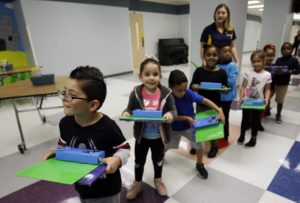
photo, students return to their classrooms after they were given school supplies, including pencils and books at Riverdale Elementary School, in Orlando, Fla. (AP Photo/John Raoux)
ORLANDO, Fla. (AP) — Ten-year-old Anthony Valencia says that after Hurricane Maria destroyed his home in Puerto Rico he played video games for a month until he was sick of them. Now his smile stretches wide when he talks about going back to school — on the U.S. mainland.
“I really wanted school back, because, without it, it’s just … bored,” Anthony said.
More than 140,000 Puerto Ricans have left since the Category 4 Hurricane slammed into the island Sept. 20 and some experts estimate more than 300,000 more could leave in the coming two years. Many have gone to Florida, followed by Pennsylvania, Texas, New York and New Jersey, according to estimates. Some estimate 14,000 public school students are among the exodus.
Last month, Anthony left the island with his family for central Florida, where he is living with relatives and has been welcomed into Orlando’s Riverdale Elementary School.
On Tuesday, he clung to his mother during a school assembly, where students received free school supplies from the Kids In Need Foundation. Like most schools in the Orange County district, Riverdale Elementary has opened its doors to the students, taking 27 of them while the district has absorbed 1,888 overall.
“Our No. 1 priority from Day 1 was to welcome our fellow American citizens into our community and into our schools, to bring normalcy back into their life,” said Orange County Public School District Deputy Superintendent Jesus Jara.
The exodus from Maria has added to what already has been an influx of Puerto Ricans in the Orlando area of central Florida in recent years. And more are expected from the ravaged island, where widespread power outages are continuing and many still lack running water.
Riverdale principal Bill Charlton has watched his school of 630 students grow quickly, and he is expecting a few more students by the end of the week. Charlton said class sizes have expanded some, but most of the classes were under state maximums prior to the influx.
“It’s been such that we just want to make sure the kids get what they need,” Charlton said.
Gov. Rick Scott made getting the students enrolled around the state a lot easier by waiving the mandate of immediately providing shot records and birth certificates. Combining the new Puerto Rican enrollees with students from island nations such as the Dominican Republic, Haiti and the Bahamas, Orange County’s 194 schools have grown by 2,429 students since the hurricane. Schools in neighboring Osceola County have seen enrollment jump by 1,479 since Hurricane Maria, with 1,352 of those students coming from Puerto Rico.
Anthony seems to be enjoying the experience and loving his new school. His mother, Arieliss Valencia, said she sees a joy every morning now in the eyes of both of her school-aged kids.
“They wake up looking forward to going to school, they’re making friends. They actually like it here,” she said. “I think this is the best thing I could have done for them.”