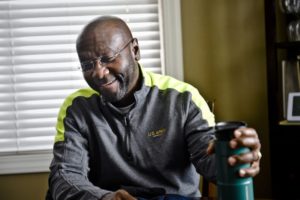
Wilmot Collins, newly elected Helena, Mont. mayor, speaks with the press in his Helena, Mont. home. Fifty years to the date after the nation’s first black mayor was elected to lead a large American city, voters in more than a half-dozen large and small cities chose African-American candidates as mayors on Tuesday. (Thom Bridge/Independent Record via AP, File)
DETROIT (AP) — When Wilmot Collins knocked on doors across Helena, Montana, residents wanted to know what he would do to address homelessness, affordable housing and other municipal issues.
“They didn’t once ask me if you think a black person can win a race in this town,” the Liberian immigrant told The Associated Press a day after his election.
Fifty years to the date after the nation’s first black mayor was elected to lead a large American city, voters in more than a half-dozen large and small cities chose black candidates as mayors Tuesday. Most of the mayors are Democrats, but some of the races were nonpartisan. Political experts say the results could have national political consequences as the Democratic Party looks to build its bench with a more diverse pool of candidates and the mayors seize opportunities to bring about change at the local level in an era of gridlock in Washington under President Donald Trump.
Vi Lyles was elected mayor of Charlotte, North Carolina, becoming the first black woman to run North Carolina’s largest city. City Councilman Melvin Carter was elected the first black mayor of St. Paul, Minnesota. Voters in Cleveland and in Flint, Michigan, re-elected black mayoral incumbents. The result in Ohio came 50 years after Carl Stokes made history in Cleveland in becoming the nation’s first big-city black mayor.
Stephanie Mash Sykes, executive director of the nonpartisan African American Mayors Association, said there are about 30 black mayors of U.S. cities with more than 100,000 residents. The 2010 Census lists more than 200 cities and regional areas that size.
Those 30 black mayors include Randall Woodfin, who defeated black incumbent William Bell last month in Birmingham, Alabama. New Orleans will be on that list as two black women are in the runoff for mayor. Atlanta City Councilwomen Keisha Lance Bottoms, who’s black, and Mary Norwood, who’s white, are headed to a runoff for Atlanta mayor.
Not all black candidates found success. Tito Jackson, a black city councilor in Boston, was defeated Tuesday by incumbent Mayor Marty Walsh, who’s white. And in Detroit, Coleman Young II, the son of the city’s first black mayor, lost to incumbent Mayor Mike Duggan, who first was elected in 2013 as Detroit’s first white mayor since 1973.
“We’ll win some. We’ll lose some,” Sykes said, but “voters are looking for a leader that’s effective in developing innovative solutions for jobs, access to affordable housing.”
The victories could translate to national politics, according to Paul Watanabe, political science professor at the University of Massachusetts Boston.
“For most of these mayors from the Democrat party, they may provide an answer to the question: Is there any new leadership on the Democratic side?” Watanabe said. “Perhaps one might look to governors or to mayors, particularly, for candidates of color who might be new or fresh on the scene.”
To some political observers, Tuesday’s general elections also were a referendum on the divisive politics and policies emanating from Washington, where Republicans control the White House, the Senate and the House of Representatives.
Helena voters shut all that down, said Collins, a psychology instructor at Helena College who left West Africa as a refugee about two dozen years ago.
“The people of Helena told (Washington) that they are an accepting community,” said Collins, who will become the city’s first black mayor since the 1800s. “We want diversity.”
Sykes, who didn’t have a historical record showing if the number of black mayors was the most ever, said the candidates elected Tuesday have an opportunity to play a large-than-usual role in setting the agenda with Washington leaders struggling to get much done.
“We don’t see much of anything to impact local communities, particularly communities of color,” she said. “These mayors are the hopes and opportunities to create solutions on the ground.”
Tuesday’s elections also saw Ravi Bhalla, a Sikh, win the mayor’s race in Hoboken, New Jersey.
In Flint, Karen Weaver fended off a recall effort and beat a number of challengers to complete the last two years of her term. The recall focused on Weaver’s decision to hire a trash hauler that became connected to a federal corruption investigation. It didn’t refer to Flint’s lead-tainted water crisis.
The city was under state control when it switched from Detroit’s water system to the Flint River in 2014 to save money. But the river water wasn’t properly treated, causing lead from pipes to leach into drinking water.
Weaver made the water problems a focus of her successful 2015 mayoral campaign and said she believes her win Tuesday gives a voice to an urban agenda.