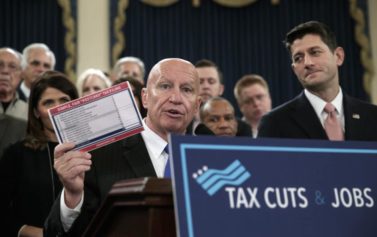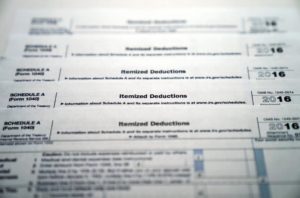
IRS Form 1040, Schedule A, Medical and Dental Expense forms shown, Monday, Nov. 6, 2017. Several million households unlucky enough to face high medical bills not covered by insurance would lose a valuable deduction under the GOP tax bill. ( Photo/Pablo Martinez Monsivais)
WASHINGTON (AP) — Several million people unlucky enough to face big medical bills not covered by their insurance would lose a valuable and versatile deduction under the House GOP tax bill. Groups representing older people and patients are trying to save it.
“Anybody who is paying for the cost of nursing home care is paying a great deal of money, and they are going to lose that deduction, and their taxes are going to go up,” said Thomas DeCoursey, a retired lawyer from Kansas, in his 70s.
He relies on the deduction to help offset costs associated with nursing home care for his wife, who has Alzheimer’s. Some of his own medical expenses also factor in. DeCoursey estimates that in a couple of years their annual costs will pass $100,000.
“There are a lot of people in my shoes,” said DeCoursey, who lives in Leawood, a well-to-do Kansas City suburb that voted for President Donald Trump last year.
About 9 million households — 6 percent of tax filers — claim the medical expense deduction, said Gordon Mermin, a senior researcher at the nonpartisan Urban-Brookings Tax Policy Center. The annual cost to the U.S. Treasury is about $10 billion, which ranks it as a modest tax break. Those who benefit tend to be middle-income and upper-middle-income people.
“For the people who claim it, it is not a trivial benefit,” said Mermin.
The medical expense deduction is also versatile. In addition to nursing home care, not generally covered by medical insurance plans, it can be used for:
—Fertility treatments.
—Transportation expenses to a top hospital, like a comprehensive cancer center.
—Laser surgery to correct vision problems.
—Some long-term care insurance premiums.
—Installing specialized medical equipment in a patient’s home or vehicle.
—Dental procedures.
—Bills from out-of-network doctors.
“When you are faced with large medical costs and don’t have a lot of options, this is one that helps people,” said Barbara Collura, president of RESOLVE: The National Infertility Association. Most insurance plans do not cover fertility treatments, which can cost from $15,000 to $30,000.
Advocacy groups pushing back against repeal may get help from the Senate.
House Republicans defend their approach.
In a statement, Ways and Means GOP spokeswoman Lauren Aronson said the bill would allow people to “keep more of the money they earn for expenses that arise throughout their lives — such as medical bills — rather than providing a myriad of provisions that many Americans may only use once in their lifetimes, and only if they go through the hassle and frustration of itemizing.”
Republicans say doing away with, or curbing, tax breaks creates a big pot of revenue, which can then be used to lower tax rates. Proponents say the lower rates and higher standard deduction in the GOP bill would compensate for the loss of particular tax breaks.
An argument against the medical deduction is that it can’t be easily claimed.
Taxpayers have to have enough deductions to itemize in the first place.
Then there’s another step. Taxpayers can only deduct medical expenses that exceed 10 percent of their income, in most cases. Take a hypothetical single man under 65 making $45,000 a year. If he had $4,000 of qualifying medical expenses, he could not deduct any of it.
Independent analyst Greg Rosica, a tax partner at the Ernst & Young accounting firm, said tax legislation has to be looked at in its totality, not through the lens of individual tax breaks.
“It is a change,” he said of the potential loss of the medical deduction. “It’s not necessarily the loss of something, but it’s something that’s being replaced and changed.”
Democrats have jumped on the issue, arguing that the medical expense deduction would be sacrificed to reduce taxes for the wealthy.
“One of the challenges Republicans have with this provision is that people can understand it,” said Rep. Richard Neal of Massachusetts, senior Democrat on the tax-writing Ways and Means Committee. “Some of this tax stuff is arcane; this is not.”
AARP, the seniors lobby, is among the groups urging Congress to keep the deduction, saying the vast majority of those who claim it are older people.
“For people who are sick, many of whom are going to be older Americans, this medical expense deduction makes their health care more affordable,” said Cristina Martin Firvida, AARP’s lead lobbyist on financial security issues. “To them, it is a very big deal.”