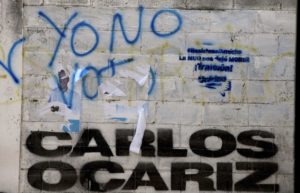
This Oct. 18, 2017 photo shows a spray-painted message on a wall that reads in Spanish; “I will not vote,” next to the name of opposition gubernatorial candidate Carlos Ocariz, in Guarenas, Venezuela. Polls favored Ocariz to win handily in Sunday’s election, but his opponent, a pro-government candidate won. A similar trend played out on a statewide level and across much of the nation as opposition candidates were hurt by high abstention rates in their strongholds. (AP Photo/Fernando Llano)
CARACAS, Venezuela (AP) — Four of the five opposition governors recently elected in Venezuela took an oath Monday before leaders of the all-powerful, pro-government constitutional assembly, reversing an earlier refusal and underlining fractures in the opposition.
The small ceremony in Caracas came less than a week after the opposition governors boycotted a swearing-in event at the constitutional assembly’s chamber. Throughout the campaign, opposition candidates said they would never yield to socialist President Nicolas Maduro’s demand that any newly elected governor take an oath and “submit” before the constitutional assembly.
Opposition leaders and dozens of foreign governments consider the assembly unconstitutional.
After initially refusing the oath, the opposition governors pressed their local legislative councils to swear them into office, as the Venezuelan constitution dictates. But the constitutional assembly, which has ruled with virtually unlimited powers since being elected in July, decreed that local councils could not swear any governor into office before they first took an oath before the assembly.
The move put the governors in a tight spot: Continue to refuse and risk losing their offices or be sworn in at the cost of caving in on a firmly held position.
Images released by the government on Twitter showed the newly elected governors of Anzoategui, Merida, Nueva Esparta and Tachira state holding up their right hands during a ceremony with Delcy Rodriguez, the assembly’s president and one of Maduro’s fiercest allies.
The elected governor of Zulia, Juan Pablo Guanipa, refused to participate, leaving up in the air what will happen in Venezuela’s largest state.
On Twitter, two of the sworn-in opposition governors appeared to defend their decision. Tachira Gov. Laidy Gomez said the “humiliation of a leader” can be a means of achieving freedom. Anzoategui Gov. Antonio Barreto said that in order to resolve the nation’s crisis they were making “the biggest of sacrifices.”
While some supporters emerged online to defend them, both governors were met with an onslaught of criticism from disappointed Venezuelans.
“Traitor!!!!!” one woman angrily wrote.
According to the Electoral Council, opposition candidates won just five of the 23 governorships up for grabs in Oct. 15 elections that the opposition had been projected to dominate.
Opposition leaders are disputing the results, claiming the Electoral Council committed fraud through a series of maneuvers designed to give government-backed candidates an edge. In Bolivar state, the Democratic Unity Roundtable has presented evidence of possible ballot tampering.
Andres Velasquez, the opposition’s candidate for governor in Bolivar, said the four opposition governors who took the oath deserve “full repudiation” by Venezuelans.
The squabbling over the oath seemed certain to sow further discord among members of the opposition, who have struggled to put forward a united message since the regional elections. While thousands of Venezuelans frustrated with their nation’s triple-digit inflation, high crime and food shortages participated in four months of protests earlier this year, more recently the opposition has struggled to mobilize supporters.
Official election results show thousands in opposition strongholds did not participate in the vote.